

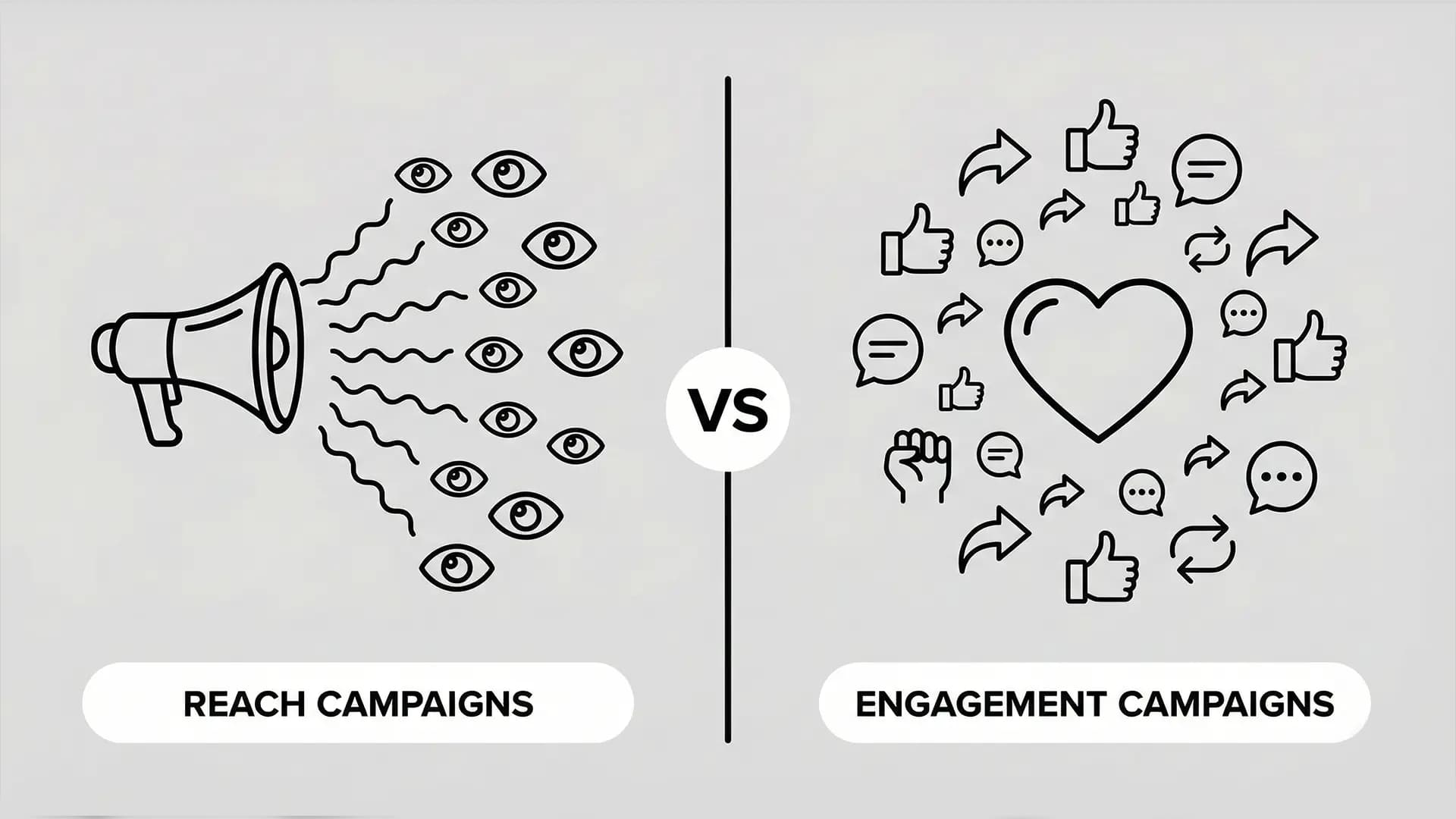
If you've ever set up a Facebook ad campaign, you've faced this choice: reach or engagement? Both objectives promise results, but they deliver entirely different outcomes. Choose wrong, and you'll burn through your budget with little to show for it. Choose right, and you'll maximize ROI while achieving your marketing goals.
This guide cuts through the confusion. You'll learn exactly what each campaign type does, when to use it, and how to decide between them based on your specific situation.
What Are Reach Campaigns?
Reach campaigns are designed for one purpose: showing your ad to as many people as possible within your target audience. Facebook's algorithm optimizes for maximum unique users reached, prioritizing broad distribution over any other metric.
The core goal? Brand awareness and visibility.
When you select "Reach" as your campaign objective, you're telling Facebook: "I want the most eyeballs possible on this content." The platform then shows your ad to the maximum number of unique users within your targeting parameters, even if those users are less likely to interact with it.
When to Use Reach Campaigns
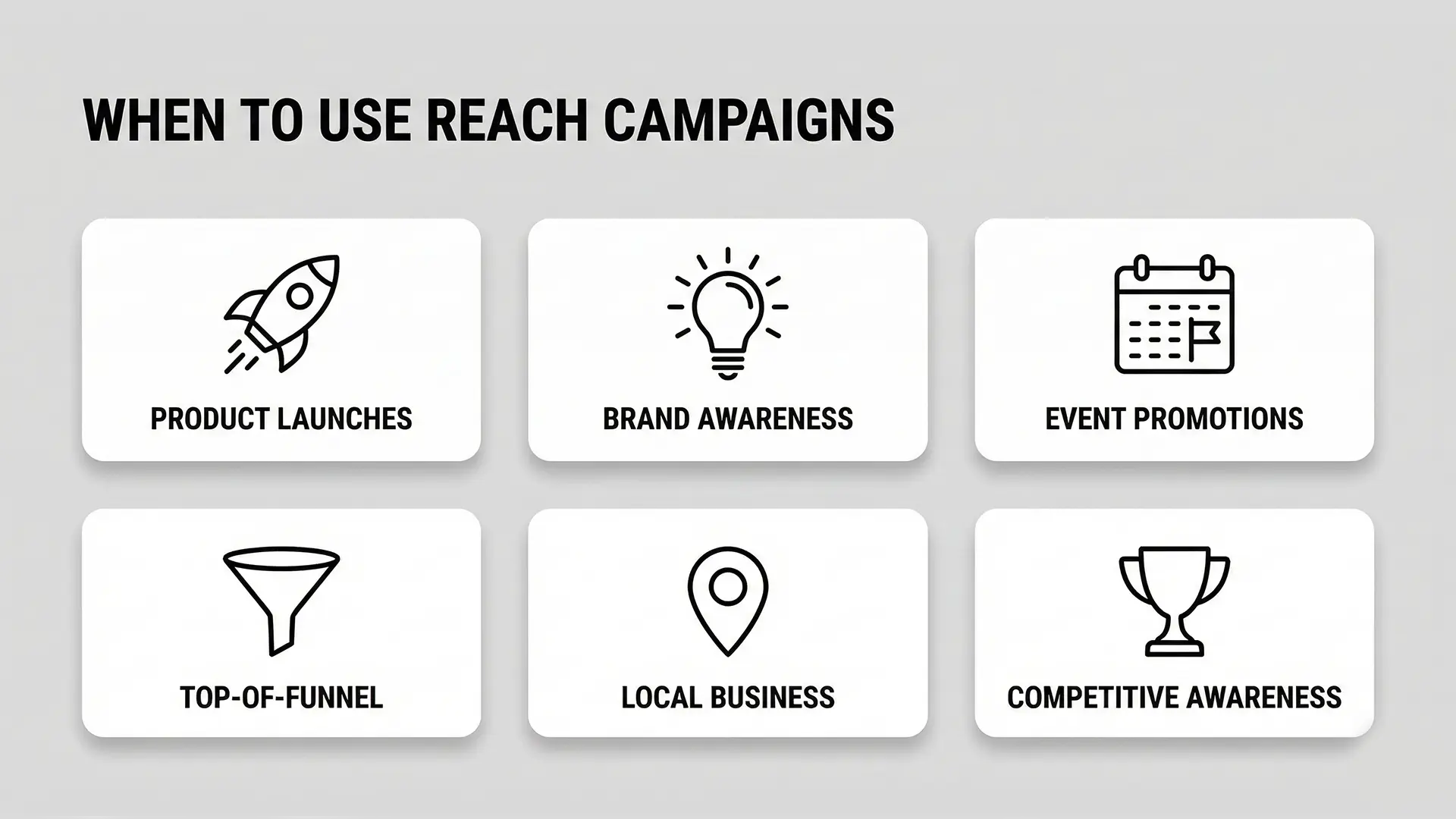
Reach campaigns excel in specific scenarios:
- Product launches: Getting a new product in front of as many potential customers as possible
- Brand awareness: Building name recognition in new or existing markets
- Event promotions: Announcing time-sensitive events, sales, or limited offers
- Top-of-funnel marketing: Creating initial awareness before nurturing leads
- Local business promotions: Saturating a geographic area with your message
- Competitive awareness: Ensuring your brand stays visible in crowded markets
Think of reach campaigns as your megaphone. They're loud, broad, and designed to make sure people know you exist.
How Reach Campaigns Work
The Facebook algorithm optimizes reach campaigns differently than other objectives:
- Broad distribution: Shows ads to maximum unique users, even if engagement likelihood is low
- Frequency management: Balances between reach and frequency (how often the same person sees your ad)
- CPM pricing: You pay per 1,000 impressions (Cost Per Mille)
- Impression-focused delivery: Prioritizes showing ads once to many people vs. multiple times to fewer people
Typical costs: $3-$15 CPM depending on audience size, targeting specificity, and competition.
What Are Engagement Campaigns?
Engagement campaigns optimize for interactions: likes, comments, shares, reactions, and link clicks on your post. Instead of maximizing reach, Facebook's algorithm finds people most likely to interact with your content and shows them your ad.
The core goal? Meaningful interactions and community building.
When you choose "Engagement" as your objective, Facebook analyzes user behavior patterns and shows your ad to people who historically interact with similar content. This creates a narrower but more engaged audience.
When to Use Engagement Campaigns
Engagement campaigns work best when you need:
- Community building: Fostering relationships and two-way conversations
- Content testing: Discovering what resonates before scaling to larger campaigns
- Social proof: Building credibility through visible interactions (likes, comments, shares)
- Retargeting audiences: Creating pools of engaged users to target later
- Customer feedback: Gathering opinions and insights through comments
- Algorithmic favor: Boosting organic reach through engagement signals
- Content amplification: Leveraging shares to expand reach organically
Engagement campaigns are your conversation starter. They prioritize quality interactions over raw visibility.
How Engagement Campaigns Work
The optimization strategy focuses on user behavior:
- Behavioral targeting: Shows ads to users with history of engaging with similar content
- Quality over quantity: Reaches fewer people but with higher interaction likelihood
- Cost per engagement: You pay per interaction (like, comment, share, click)
- Engagement-focused delivery: Repeatedly shows ads to high-engagement users
- Social proof amplification: Visible engagement attracts more organic engagement
Typical costs: $0.05-$0.50 per engagement, varying by content quality, audience, and industry.
Key Differences: Side-by-Side Comparison
Here's what actually separates these campaign types:
| Dimension | Reach Campaigns | Engagement Campaigns |
|---|---|---|
| Primary Goal | Maximize impressions and unique users | Maximize interactions (likes, comments, shares) |
| Optimization | Shows ads to maximum people | Shows ads to users likely to interact |
| Cost Metric | CPM (Cost Per 1,000 Impressions) | Cost Per Engagement (CPE) |
| Audience Size | Broader, less filtered | Narrower, quality-focused |
| Funnel Stage | Top of funnel (awareness) | Middle of funnel (consideration) |
| Typical CPM | $3-$15 | N/A (uses CPE instead) |
| Frequency | Lower per user | Higher per user |
| Best Creative | Eye-catching visuals, simple messaging | Conversation-starters, authentic content |
| Ideal for Budget | Medium to large budgets ($500+) | Small to medium budgets ($200+) |
| Speed to Results | Fast (impressions accumulate quickly) | Moderate (quality takes time) |
| Retargeting Value | Creates broad awareness audiences | Creates highly engaged audiences |
The fundamental difference? Reach campaigns ask "How many people can see this?" Engagement campaigns ask "Who will care about this?"
When to Choose Each Campaign Type
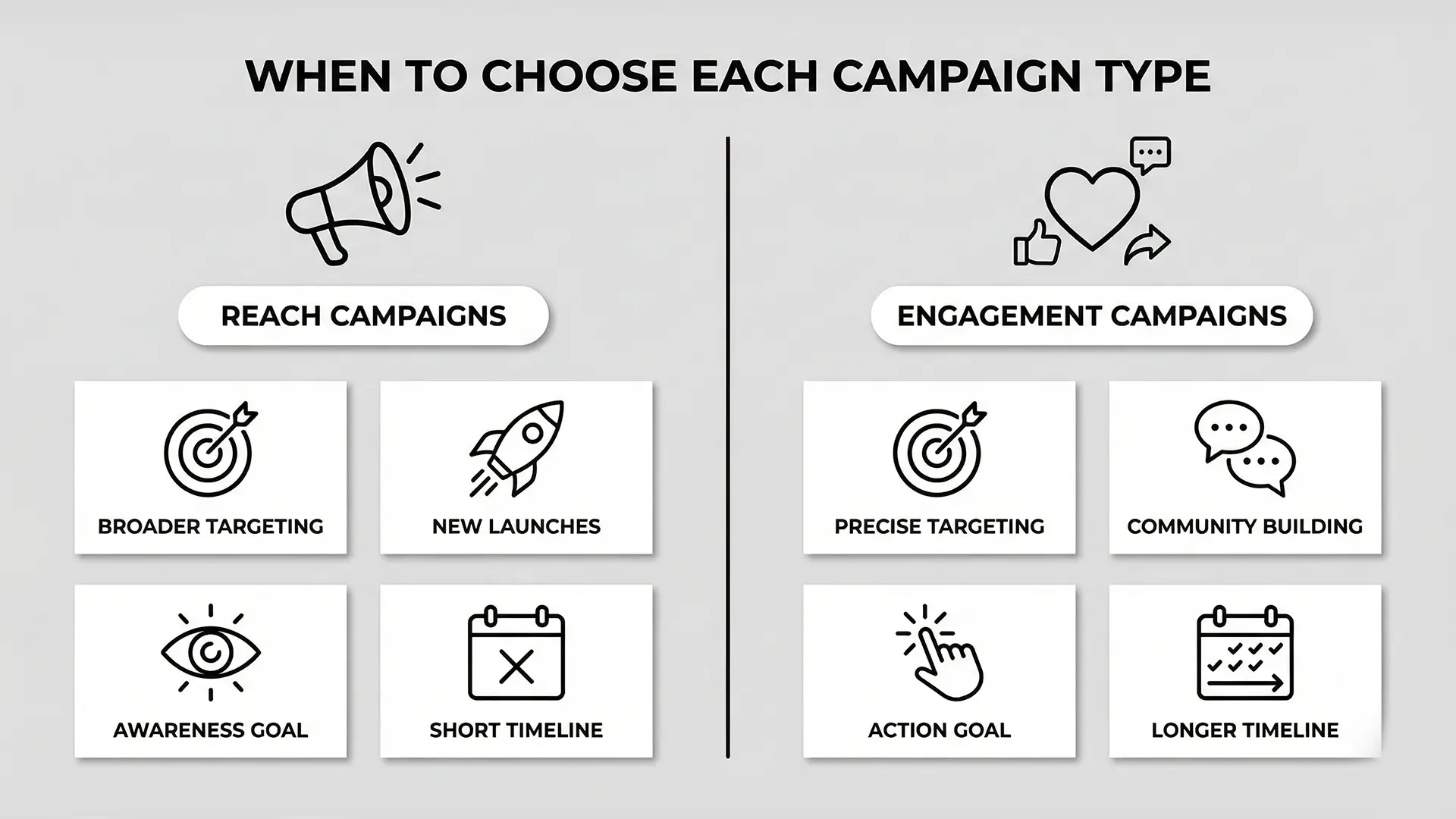
Choose Reach Campaigns When:
You should prioritize reach in these situations:
- You're launching something new: New products, services, or business openings benefit from maximum visibility
- Time is critical: Event promotions, flash sales, or limited-time offers need rapid awareness
- Building initial awareness: First-time market entry requires broad exposure before targeted campaigns
- Your budget is substantial: Reach campaigns scale efficiently with larger budgets ($1,000+)
- Geographic saturation matters: Local businesses needing area-wide awareness
- You're running brand campaigns: Pure awareness goals without immediate conversion expectations
- Creating retargeting pools: Building large audiences of people aware of your brand
Real-world example: A local bakery launching a new location ran a $300 reach campaign targeting a 10-mile radius. Result: 45,000 local residents saw the ad, driving 200+ in-store visits on opening week. The goal wasn't engagement—it was saturation.
Choose Engagement Campaigns When:
Engagement campaigns win in these scenarios:
- You're building community: Relationship-building requires two-way interaction
- Testing creative: Want to know what resonates before scaling? Engagement reveals content quality
- Budget is limited: Small budgets ($200-$500) get more value from quality interactions than impressions
- You need social proof: Visible engagement builds credibility for future campaigns
- Creating warm audiences: Engaged users convert 40% better in retargeting campaigns
- Content-driven strategy: Your marketing centers on valuable content rather than direct selling
- Want feedback: Comments provide customer insights and market research
- Algorithm advantage: Facebook rewards engagement, potentially boosting organic reach
Real-world example: A fitness coach spent $500 on an engagement campaign promoting a free workout guide. The campaign generated 2,400 engagements and created an audience of interested users. When she retargeted them with her paid program, conversion rate was 18%—nearly 3x the industry average.
Use Both Campaigns When:
Sequential or parallel campaigns make sense if:
- You have sufficient budget: $2,000+/month allows testing both objectives
- Running full-funnel campaigns: Reach builds awareness, engagement nurtures interest
- Your product needs education: Reach introduces the concept, engagement dives deeper
- Testing strategy: Run both to compare performance and optimize future campaigns
Sequential strategy example: An e-commerce brand allocated $2,000 for a holiday sale. They ran a reach campaign ($800) for 5 days building awareness (150,000 reach), then switched to engagement ($800) to drive shares and comments (3,200 engagements). Final conversion campaign ($400) targeted both audiences, achieving 4.2x ROI.
Budget Considerations: What Can You Afford?
Your budget significantly impacts which campaign type makes sense.
Small Budget (Under $500/month)
Recommendation: Start with engagement campaigns.
Why? Engagement campaigns typically have lower minimum thresholds and deliver measurable results with smaller budgets. You'll build social proof, test creative, and create engaged audiences for future campaigns.
Strategy:
- Allocate 70% to engagement campaigns
- Use 30% for reach during critical launches or time-sensitive promotions
- Focus on quality over quantity
- Leverage organic reach from shares
Medium Budget ($500-$2,000/month)
Recommendation: Test both with a 60/40 split.
Why? You have enough budget to explore both objectives and compare performance. Allocate 60% to your primary goal (awareness or engagement) and 40% to testing the other.
Strategy:
- If building brand: 60% reach, 40% engagement
- If building community: 60% engagement, 40% reach
- Track which audiences convert better
- Gradually shift budget to higher-performing objective
Large Budget (Over $2,000/month)
Recommendation: Run both simultaneously with strategic segmentation.
Why? Larger budgets allow full-funnel strategies. Use reach for cold audiences and engagement for warming prospects.
Strategy:
- Reach campaigns: 50% budget, cold audiences, awareness focus
- Engagement campaigns: 30% budget, warm audiences, content testing
- Conversion campaigns: 20% budget, engaged audiences, sales focus
- Create audience funnels: Reach → Engagement → Conversion
Best Practices for Reach Campaigns
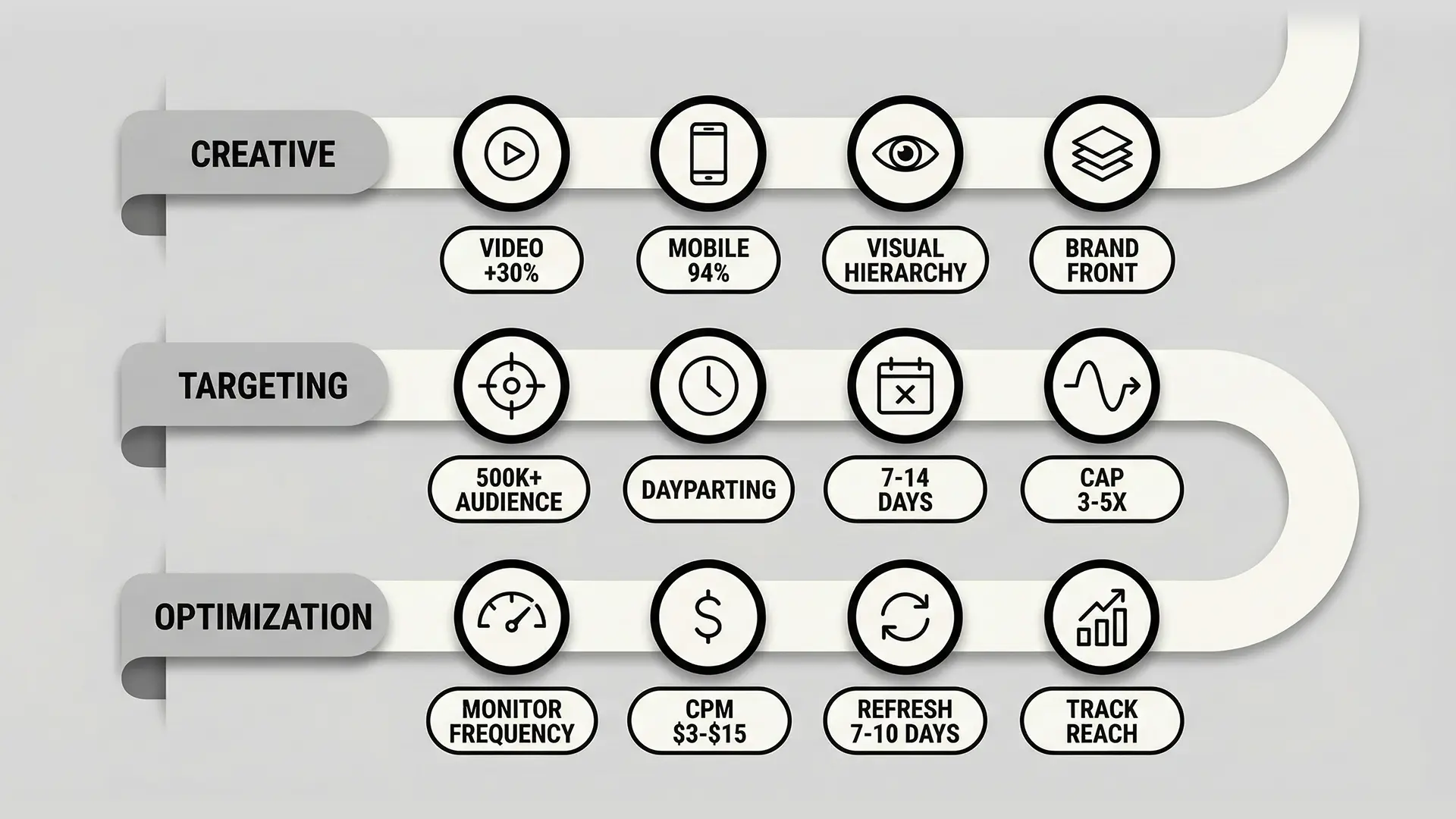
Maximize your reach campaign performance with these tactics:
Creative and Messaging
- Use video content: Videos generate 30% more impressions than static images
- Keep it simple: You have 2-3 seconds to grab attention—make it count
- Strong visual hierarchy: Clear focal point, minimal text, bold colors
- Brand front and center: Ensure brand recognition even with brief exposure
- Mobile-first design: 94% of Facebook ad impressions happen on mobile
Targeting and Settings
- Go broader: Reach campaigns perform better with larger audiences (500,000+)
- Set frequency caps: Limit impressions to 3-5 per user to avoid ad fatigue
- Use reach and frequency buying: For predictable delivery and cost control (available for larger budgets)
- Dayparting: Schedule ads during hours when your audience is most active
- Duration: Run for 7-14 days for optimal frequency distribution
Optimization
- Monitor frequency: If frequency exceeds 5, you're oversaturating—refresh creative or expand audience
- Track unique reach: Focus on unique users reached, not total impressions
- CPM benchmarking: Compare your CPM to industry averages ($3-$15) to assess efficiency
- Creative refresh: Swap creative every 7-10 days to combat ad fatigue
Best Practices for Engagement Campaigns
Get more from your engagement campaigns with these strategies:
Creative and Messaging
- Ask questions: Posts ending with questions receive 100% more comments
- Create controversy (carefully): Thought-provoking takes drive discussion
- Use authentic content: User-generated content and behind-the-scenes posts outperform polished ads
- Tell stories: Narrative-driven content encourages emotional engagement
- Include clear CTAs: "What do you think?" or "Tag someone who needs this"
Targeting and Settings
- Narrow your audience: Engagement campaigns work better with specific audiences (50,000-200,000)
- Interest-based targeting: Target people interested in your niche, not just demographics
- Lookalike audiences: Create lookalikes from your most engaged customers
- Exclude existing engagers: After initial boost, exclude people who've already engaged to expand reach
Optimization
- Respond to comments: Engagement breeds more engagement—reply within 1 hour if possible
- Boost top performers: If organic posts get early engagement, boost them with ad spend
- Test posting times: Experiment with different times to find peak engagement windows
- Quality over quantity: One highly engaging post beats five mediocre ones
- Track comments-to-likes ratio: Healthy ratio is 1 comment per 10-20 likes; higher ratios indicate quality engagement
How to Measure Success
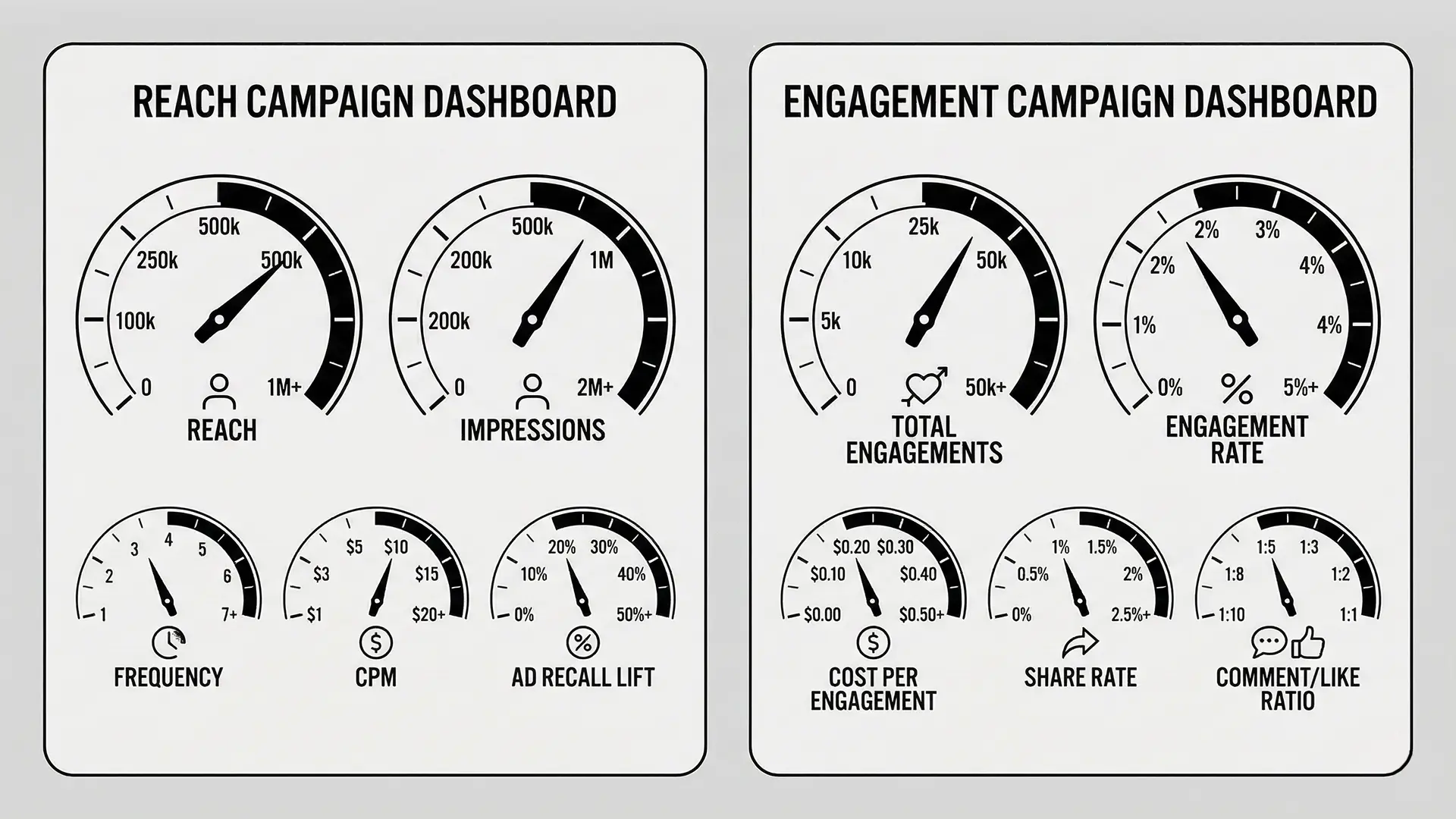
Success metrics differ significantly between campaign types.
Reach Campaign Metrics
Focus on these KPIs:
- Reach: Total unique users who saw your ad (primary metric)
- Impressions: Total number of times your ad was shown
- Frequency: Average impressions per user (target: 2-4)
- CPM: Cost per 1,000 impressions (benchmark against $3-$15)
- Estimated ad recall lift: Facebook's prediction of how many people will remember your ad
- Brand lift studies: Survey-based measurement of awareness increase
Success benchmark: Good reach campaigns achieve CPM of $5-$10 with frequency under 4 and reach exceeding 60% of target audience.
Engagement Campaign Metrics
Track these indicators:
- Total engagements: Sum of likes, comments, shares, and clicks
- Engagement rate: Engagements divided by impressions (benchmark: 1-3% is good)
- Cost per engagement: Total spend divided by total engagements (target: $0.10-$0.30)
- Comment-to-like ratio: Comments divided by likes (higher is better, indicates quality)
- Share rate: Shares are highest-value engagement (1 share ≈ 10 likes in value)
- Engaged audience size: Number of users who interacted (for retargeting)
Success benchmark: Strong engagement campaigns achieve 2%+ engagement rate, $0.10-$0.25 cost per engagement, and 10%+ share of total engagements coming from shares.
Advanced Tracking
For both campaign types, implement:
- UTM parameters: Track traffic and conversions from campaign in Google Analytics
- Facebook Pixel: Measure downstream conversions even if that's not the primary objective
- Audience building: Save high-performers for retargeting in conversion campaigns
- A/B testing: Split test creative, copy, audiences, and placements
- Cohort analysis: Track behavior of reached/engaged users over 30-90 days
Making Your Decision: A Practical Framework
Still not sure which campaign to choose? Use this decision tree:
Step 1: Define Your Primary Goal
Ask yourself: "What does success look like?"
- Success = People know my brand exists → Consider Reach
- Success = People interact with my content → Consider Engagement
- Success = People buy my product → Neither (use Conversion campaigns instead)
Step 2: Assess Your Business Stage
Where is your business?
- New business or new market: Reach first, engagement second
- Established with small following: Engagement first, reach second
- Established with large following: Both simultaneously or test which performs better
Step 3: Evaluate Your Budget
What can you invest?
- Under $500: Engagement (better ROI on small budgets)
- $500-$2,000: 60/40 split based on primary goal
- Over $2,000: Both, with strategic sequencing
Step 4: Consider Your Timeline
How quickly do you need results?
- Urgent (1-7 days): Reach (fast awareness)
- Short-term (1-4 weeks): Engagement (build foundation)
- Long-term (ongoing): Both (full-funnel approach)
Step 5: Review Your Content
What are you promoting?
- Simple, visual message: Reach
- Complex, discussion-worthy content: Engagement
- Time-sensitive offer: Reach
- Evergreen valuable content: Engagement
Common Mistakes to Avoid
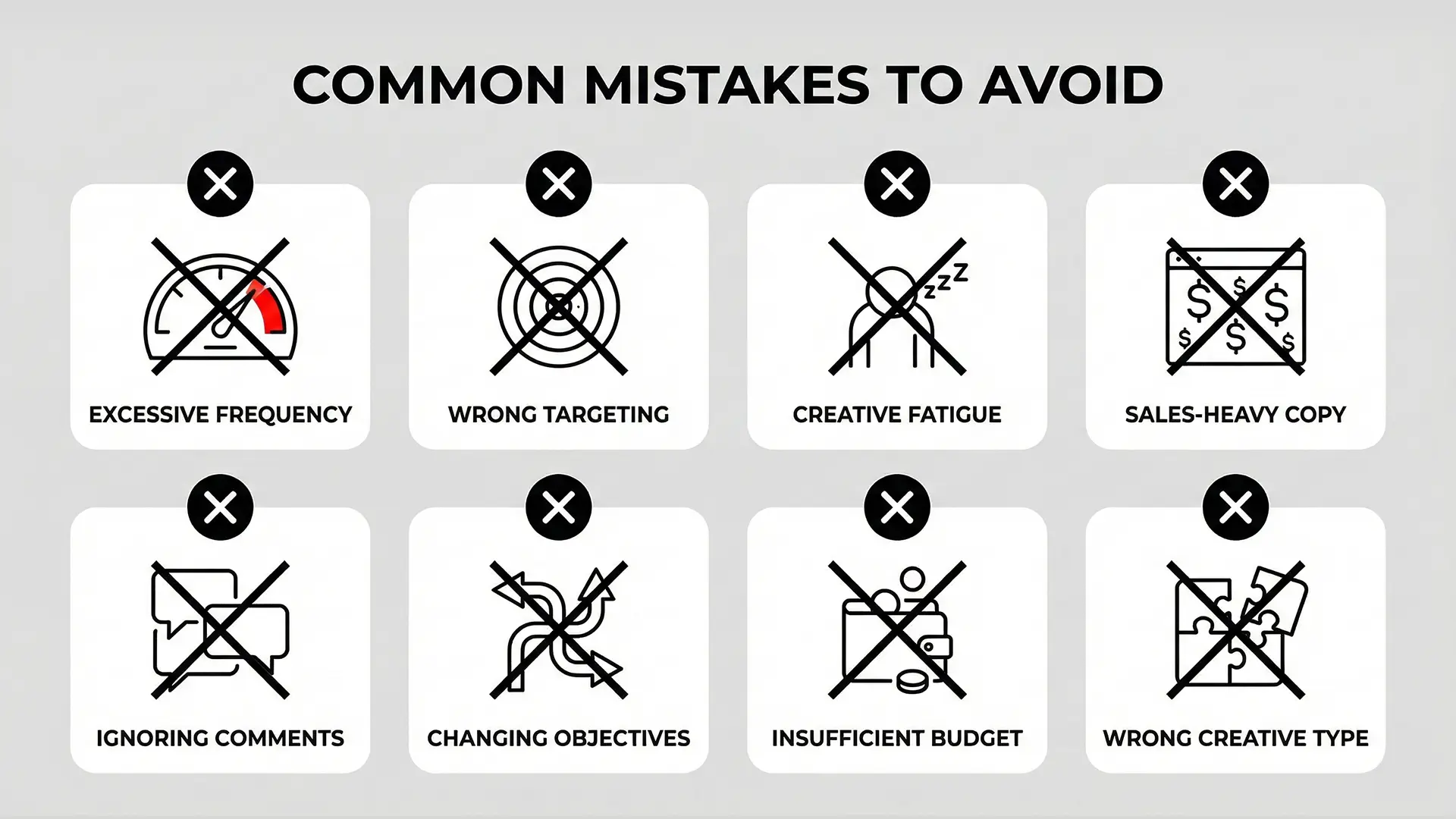
Don't sabotage your campaigns with these errors:
Reach Campaign Mistakes
- Setting frequency too high: Showing the same ad 10+ times annoys people and wastes budget
- Targeting too narrow: Small audiences can't generate efficient reach
- Ignoring creative fatigue: Running same creative for weeks kills performance
- Focusing on wrong metrics: Reach campaigns shouldn't be judged by engagement rate
Engagement Campaign Mistakes
- Using sales-heavy messaging: Overly promotional content kills engagement
- Ignoring comments: Not responding signals you don't value interaction
- Targeting too broad: Massive audiences dilute engagement quality
- Forgetting to retarget: Engaged audiences are gold for conversion campaigns—use them
Universal Mistakes
- Switching objectives mid-campaign: Changes reset algorithm learning
- Insufficient budget: Running both objectives with tiny budgets (<$200 each) limits effectiveness
- No testing plan: Running one campaign without comparing performance
- Mismatched creative and objective: Using engagement-style creative for reach campaigns (or vice versa)
Final Recommendations
Here's your action plan based on everything we've covered:
If You're Just Starting
Recommendation: Begin with a small engagement campaign ($200-$300) to test creative and build social proof. Once you have proven content with solid engagement, scale to reach campaigns to amplify what works.
Why? Engagement campaigns reveal what resonates with your audience without requiring large budgets. You'll gain insights and social proof before investing in broader reach.
If You're Established But Growing
Recommendation: Run both campaigns with 60% budget to reach (awareness) and 40% to engagement (nurturing). Create a funnel: Reach → Engagement → Conversion.
Why? You need both awareness and relationship-building. Use reach to fill the funnel, engagement to warm prospects, and conversion campaigns to close the sale.
If You're Resource-Constrained
Recommendation: Focus exclusively on engagement campaigns. Build community, gather feedback, and create highly engaged audiences for later conversion campaigns.
Why? Engagement delivers better ROI on limited budgets and creates compounding value through organic reach and retargeting opportunities.
If You Have Significant Budget
Recommendation: Run sophisticated full-funnel campaigns using both objectives simultaneously. Allocate 50% to reach (cold audiences), 30% to engagement (warm audiences), and 20% to conversions (hot audiences).
Why? You can afford to build comprehensive customer journeys from first awareness through conversion, optimizing each stage independently.
The Bottom Line
The choice between reach and engagement campaigns isn't about which is "better"—it's about which aligns with your specific goals, budget, and business stage.
Choose reach when you need maximum visibility, rapid awareness, or market saturation. It's your megaphone.
Choose engagement when you need quality interactions, community building, or want to test content on a limited budget. It's your conversation starter.
Choose both when you have the budget to run full-funnel campaigns that build awareness AND relationships simultaneously.
Start by defining your primary goal, assessing your budget, and selecting the campaign type that matches both. Track your metrics religiously, test continuously, and don't be afraid to shift strategy as you learn what works for your specific audience.
The campaigns that perform best? The ones aligned with clear objectives, supported by appropriate budgets, and optimized based on real data—not guesswork.
Now you know the difference. The only question left is: which campaign will you launch first?