

Introduction
If you've ever celebrated hitting #1 rankings only to watch conversions flatline, you know the disconnect. 60% of searches now end without a click. When AI Overviews appear? 83%.
Your rankings are intact. But organic CTR dropped 61% the moment Google's AI summaries arrived. Translation: Last year's dashboard measures the wrong things.
Yet SEO delivers 748% average ROI. B2B SaaS companies achieve 702% ROI with 7-month breakeven. The winners evolved measurement first.
1. What Is SEO Analytics?
SEO analytics is the systematic measurement of organic search visibility and its contribution to business outcomes. The core goal? Understanding which strategies drive revenue—not just traffic.
What's changed in 2026: Traditional metrics like backlinks predict only 4-7% of AI citation behavior (Lily Ray, Amsive Research). The new signals? Content freshness under 13 weeks (+67% AI citations), schema markup (3.7x citation likelihood), natural language URLs (+11.4% citations).
This means measuring visibility across Google organic results, AI Overviews, featured snippets, and platforms like ChatGPT, Perplexity, Gemini—while connecting impressions to revenue through multi-touch attribution.
2. Why SEO Analytics Matters More Than Ever
748% average ROI across 12 industries (FirstPageSage 2024, N=885). B2B SaaS: 702% ROI at 7-month breakeven. These returns dwarf paid advertising (200-400% ROI).
The problem? 33% of marketers cite ROI measurement as their #1 SEO challenge.
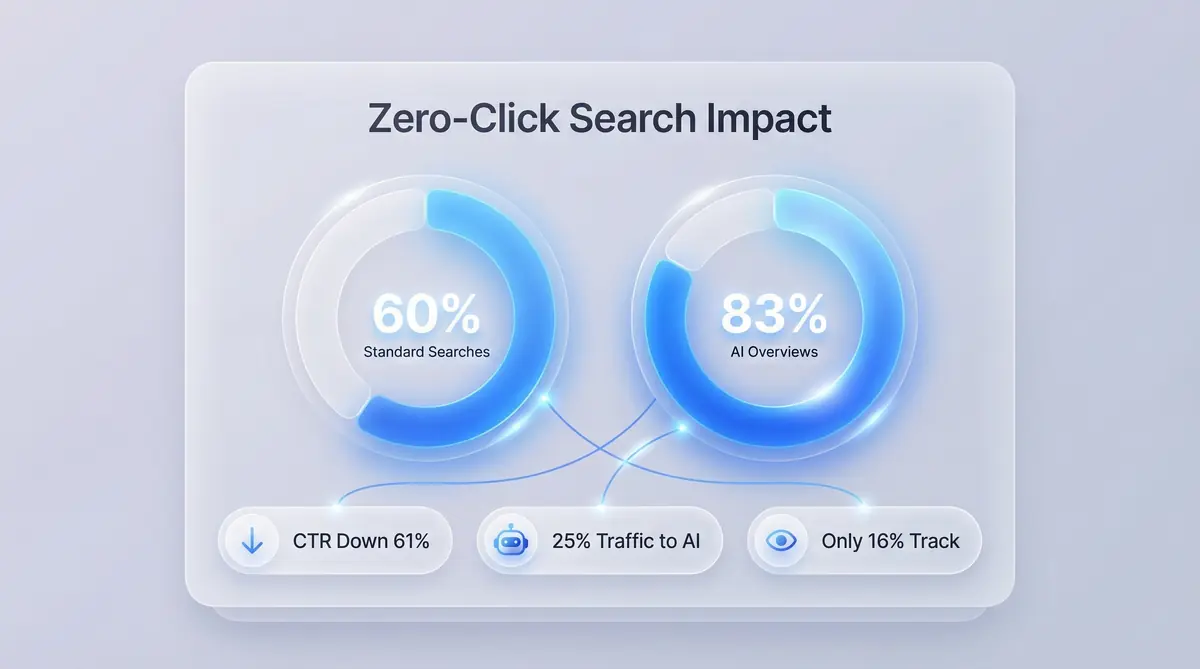
Zero-click searches jumped from 56% (May 2024) to 69% (May 2025). When AI Overviews appear: 83% (Semrush, N=1.2M). Your content influences decisions even when users never visit.
Gartner predicts 25% of organic traffic shifts to AI chatbots by year-end 2026. Google's market share fell to 89.73%—below 90% for the first time since 2015.
Despite the 61% CTR decline, only 16% track AI search impact (Search Engine Journal, N=840). That's your window.
3. When to Use Different SEO Metrics
Choose Impressions + AI Share of Voice When:
- Zero-click queries dominate your niche: If you target informational queries, 83% may show AI Overviews that answer without clicks.
- Brand visibility is the primary goal: C-suite executives consume AI summaries without clicking.
- You operate in YMYL categories: Google increasingly answers health, finance, legal queries directly.
Real-world example: Healthline achieved 125 million monthly visitors by optimizing for 15,000+ featured snippets.
Choose CTR + Organic Traffic When:
- Transactional intent drives your business: E-commerce, SaaS trials, lead-gen forms require clicks.
- Long-tail commercial keywords: Queries like "best marketing attribution software" still generate 28% average CTR for top positions.
Choose Multi-Touch Attribution When:
- Sales cycles exceed 6 months: B2B SaaS averages 9 months, 8.4 stakeholders, 31.2 touchpoints per deal (Gartner, N=300). Last-click misses 80-90% of organic's value.
- Marketing budget exceeds $500K/year: Companies see 37% improvement in budget allocation after implementing multi-touch (Gartner, N=420).
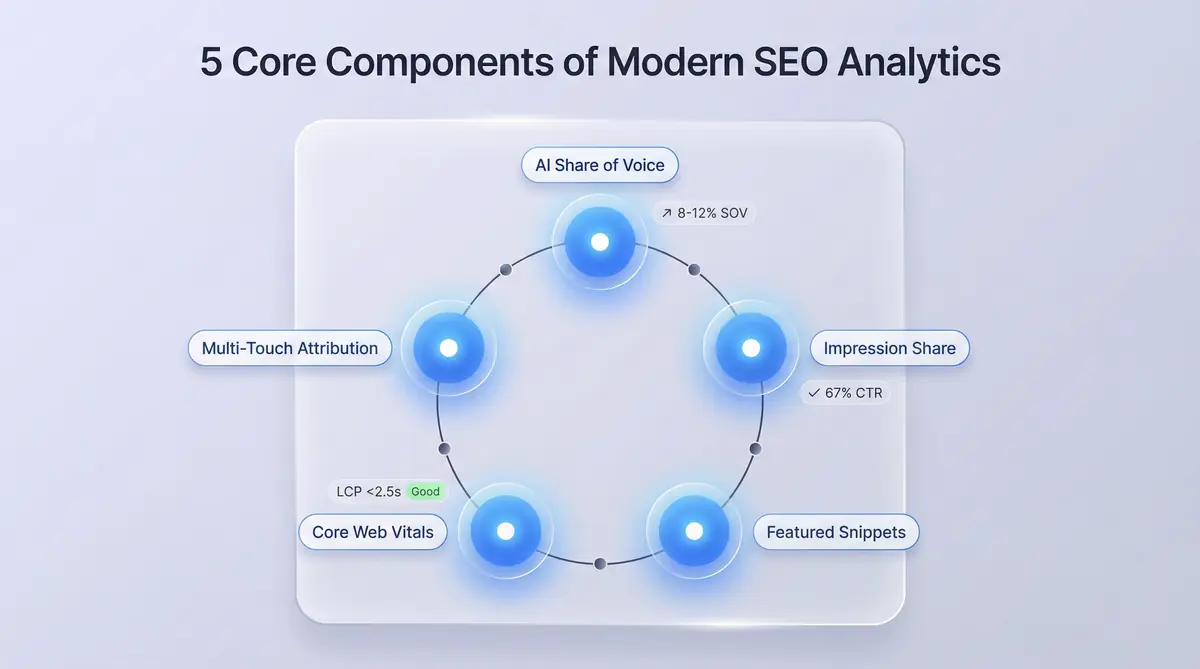
4. The 5 Core Components of Modern SEO Analytics
1. AI Share of Voice (SOV)
Percentage of brand mentions across ChatGPT, Perplexity, Gemini, Google AI Overviews when users query your target topics.
Why it matters: Brian Dean (Backlinko): "In 2026, that's no longer just rankings—it's AI Share of Voice." Traditional backlinks predict only 4-7% of AI citation behavior.
Benchmark: B2B SaaS companies average 8-12% AI SOV. Top quartile: 18-24%.
2. Impression Share (Not Just CTR)
60% of searches are zero-click. Impressions measure visibility even without clicks.
A blog post with 50,000 impressions and 500 clicks (1% CTR) isn't "failing." It delivered 49,500 brand impressions.
3. Featured Snippet Capture Rate
Featured snippets achieve 67% CTR versus 28% for standard position #1—a 39 percentage point advantage (Ahrefs, N=5.2M keywords).
Benchmarks: Bottom quartile: < 5%, Median: 12%, Top quartile: 23%+
4. Core Web Vitals
LCP (< 2.5s), INP (< 200ms), CLS (< 0.1). INP replaced FID in March 2024.
35% of mobile sites fail Core Web Vitals. 53% abandon pages over 3 seconds. Barry Schwartz: "Fix them for your users, not for Google."
5. Multi-Touch Attribution Revenue
Last-click credits paid ads with 58-65% of conversions, when reality is closer to 22-24% (Gartner, N=420).
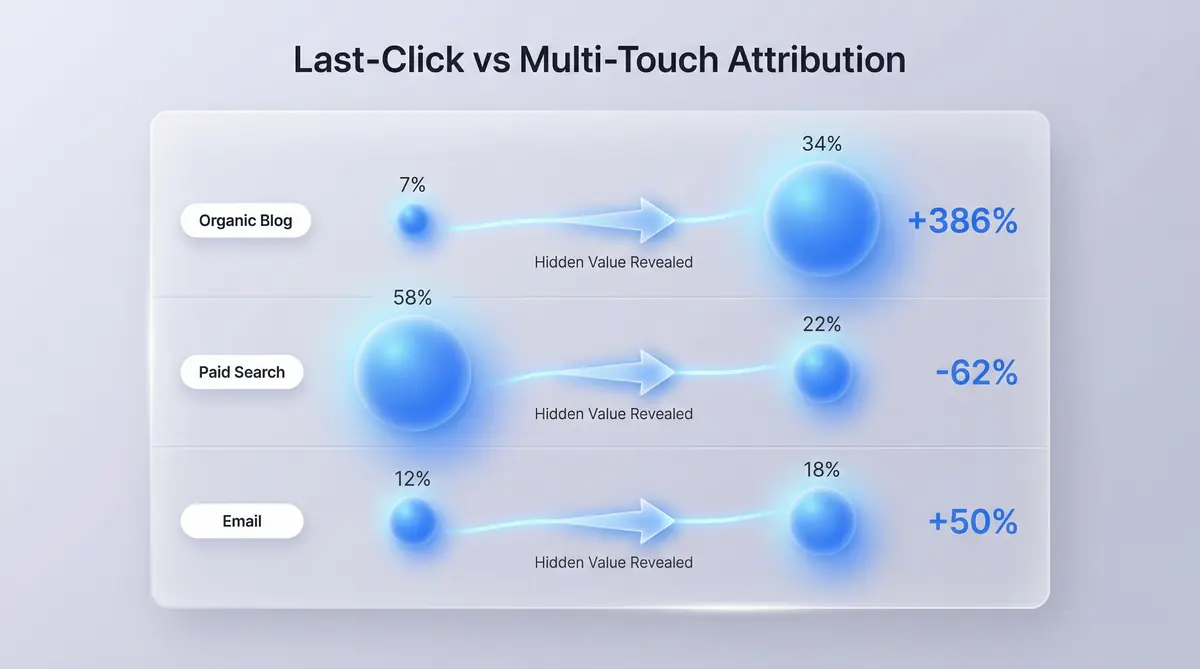
| Touchpoint | Last-Click Credit | Multi-Touch Credit | Gap |
|---|---|---|---|
| Organic blog | 7% | 34% | +386% |
| Paid search | 58% | 22% | -62% |
| Email nurture | 12% | 18% | +50% |
Companies using multi-touch discover $112K median in redirectable ad spend annually.
5. Best Practices for SEO Analytics
Measurement and Tracking
- Set up GA4 custom events: Track scroll depth, video plays, PDF downloads. These signals predict which content drives conversions.
- Implement schema markup: FAQ and HowTo schema increase AI citation likelihood by 3.7x (CXL).
- Monitor AI citations weekly: Search brand queries in ChatGPT, Perplexity, Google AI Overviews.
Content Optimization
- Update content every 3 months: Content updated in the past 3 months receives 6 citations versus 3.6 for older content (CXL, N=12,000). 50% of top AI-cited content is under 13 weeks old.
- Build topic clusters: Organize content into pillar pages (2,500+ words) linking to 10-20 cluster articles. HubSpot's model drove 1.2 million keyword rankings.
- Write natural language URLs: URLs with 5-7 descriptive words drive 11.4% more AI citations. Example:
/marketing-attribution-models-comparisonbeats/attr-models.
Technical and Performance
- Achieve Core Web Vitals on mobile: Google uses mobile-first indexing—mobile performance determines desktop rankings. Prioritize LCP < 2.5s, INP < 200ms, CLS < 0.1.
- Fix crawl errors immediately: Check Google Search Console > Coverage report weekly.
- Implement internal linking: Link from high-authority pages to new content.
Reporting and Analysis
- Report impressions alongside clicks: Create Looker Studio dashboards showing impression trends, position changes, CTR shifts.
- Segment by search intent: Group queries into informational, commercial, transactional. Apply different metrics to each.
- Benchmark against competitors: Compare your organic share of voice against top 3 competitors.
6. Common Mistakes to Avoid
Ignoring AI Search Impact
Only 16% track AI search visibility despite 61% CTR decline from AI Overviews.
The fix: Add AI Share of Voice tracking using HubSpot AEO Grader. Audit which content ChatGPT, Perplexity, Gemini cite monthly.
Optimizing for Rankings, Not User Value
Chasing #1 positions without considering genuine value. Keyword-stuffed thin content may briefly rank but fails Google's E-E-A-T evaluation.
The fix: Apply "People-First Content" framework. Ask: "Would someone find this useful if they arrived directly, bypassing search?"
Neglecting Content Freshness
Publishing once and never updating. Content over 13 weeks old receives 67% fewer AI citations.
The fix: Schedule quarterly content audits. Update statistics, add case studies, refresh screenshots. Republish with updated timestamps.
Measuring Vanity Metrics Instead of Revenue
Celebrating traffic increases without connecting sessions to revenue. 33% of marketers cite ROI measurement as their #1 SEO challenge (HubSpot).
The fix: Implement multi-touch attribution in GA4 or ObserviX. Tag organic sessions with UTM parameters to track assisted conversions.
Ignoring Technical SEO Health
Focusing solely on content while 35% of mobile sites fail Core Web Vitals. Slow page speed, broken links sabotage excellent content.
The fix: Run monthly audits with Screaming Frog or Sitebulb. Prioritize fixes: mobile errors, crawl errors, missing schema, Core Web Vitals.
7. Traditional SEO vs AI-Era SEO
| Dimension | Traditional SEO | AI-Era SEO (2025-2026) |
|---|---|---|
| Primary Metric | Keyword rankings | AI Share of Voice + Impressions |
| Traffic Goal | Maximize sessions | Maximize visibility (impressions + citations) |
| Content Freshness | Update yearly | Update quarterly (< 13 weeks) |
| Link Building | Domain authority, backlinks | E-E-A-T signals, topical relevance |
| SERP Features | Featured snippets bonus | Featured snippets + AI Overviews critical |
| Platform Coverage | Google only | Google + ChatGPT + Perplexity + Gemini |
| Attribution | Last-click or first-click | Multi-touch across 31+ touchpoints |
| ROI Calculation | Traffic × avg order value | Assisted conversions + brand lift |
8. Budget Considerations for SEO Analytics
Small Budget (Under $1,000/month)
Recommendation: Free stack—Google Search Console, GA4, Looker Studio, Ubersuggest.
Why? Provides 80% of essential data at zero cost. Track rankings, impressions, clicks, Core Web Vitals.
Limitation: No AI visibility tracking.
Medium Budget ($1,000-$5,000/month)
Recommendation: Semrush or Ahrefs + HubSpot AEO Grader + ObserviX.
Why? Professional SEO platforms provide historical data, competitor analysis, backlink monitoring. HubSpot adds AI citation tracking. ObserviX connects organic search to revenue attribution.
ROI justification: Time savings 4 hrs/week × $100/hr = $1,600/month. Better allocation: $1,850/month. Net: 5.5x return.
Large Budget (Over $5,000/month)
Recommendation: Enterprise platforms like Conductor, BrightEdge, or seoClarity + custom AI SOV tracking.
Why? Enterprise tools offer API integrations, custom reporting, predictive analytics. 86% of enterprise SEO professionals integrated AI tools (BrightEdge), 83% report improved performance.
9. Real-World Example
Sarah Chen, VP Marketing at TechStart Inc. ($8M ARR, B2B SaaS), couldn't prove SEO's revenue contribution. The CFO threatened a 30% budget cut because last-click showed paid driving 68% of pipeline while organic got only 7%.
The Solution: TechStart implemented multi-touch attribution connecting GA4 → Salesforce → revenue. They began quarterly content updates and AI citation tracking.
Results (12 months, 94 deals):
| Metric | Before | After | Change |
|---|---|---|---|
| Content Credit | 7% | 31% | +343% |
| Paid Credit | 65% | 24% | -63% |
| Marketing ROI | 2.8x | 4.1x | +46% |
Content drove 31% but received 7% of budget. Action: Moved $140K from paid to content.
12-month results: Incremental pipeline: +$620K (4.4x return). Wasted spend eliminated: $112K.
Sarah's reflection: "I almost cut content by $50K based on last-click. Multi-touch attribution literally saved our highest-ROI channel. That mistake would've cost us $620K in pipeline."
10. Key Takeaways
- Measure AI Share of Voice alongside rankings—60-83% of searches end without clicks, making impressions and AI citations more important than CTR.
- Update content every 3 months—fresh content receives 67% more AI citations than outdated pages (CXL, N=12,000).
- Implement schema markup immediately—FAQ and HowTo schema increase AI citation likelihood by 3.7x (CXL AEO Study).
- Track multi-touch attribution, not last-click—B2B journeys average 31 touchpoints across 8 stakeholders; organic content often assists rather than closes.
- Fix Core Web Vitals for users, not Google—while ranking correlation is weak, the connection to conversion rates is strong.
- ROI remains exceptional despite disruption—748% average SEO ROI proves search investment still delivers, but requires new measurement frameworks.