

Types of Marketing Attribution Models and Their Applications
An Authoritative Guide for Modern Marketers
Introduction: The Hidden Power of Attribution
Imagine a potential customer discovering your brand through a YouTube ad, later reading a blog post, clicking a retargeting ad, and finally purchasing after receiving an email offer. Which of these touchpoints deserves credit for the conversion?
This question lies at the heart of marketing attribution—the process of identifying which channels and interactions truly influence customer decisions. With the growth of complex digital ecosystems, accurate attribution is not just a technical challenge; it is a strategic necessity for marketers aiming to maximize ROI and allocate budgets effectively.
In this article, we’ll explore the most recognized types of attribution models, examine their practical applications, and outline how data-driven approaches—like those embedded in Google Analytics 4—are reshaping modern marketing analysis.
What Is Marketing Attribution?
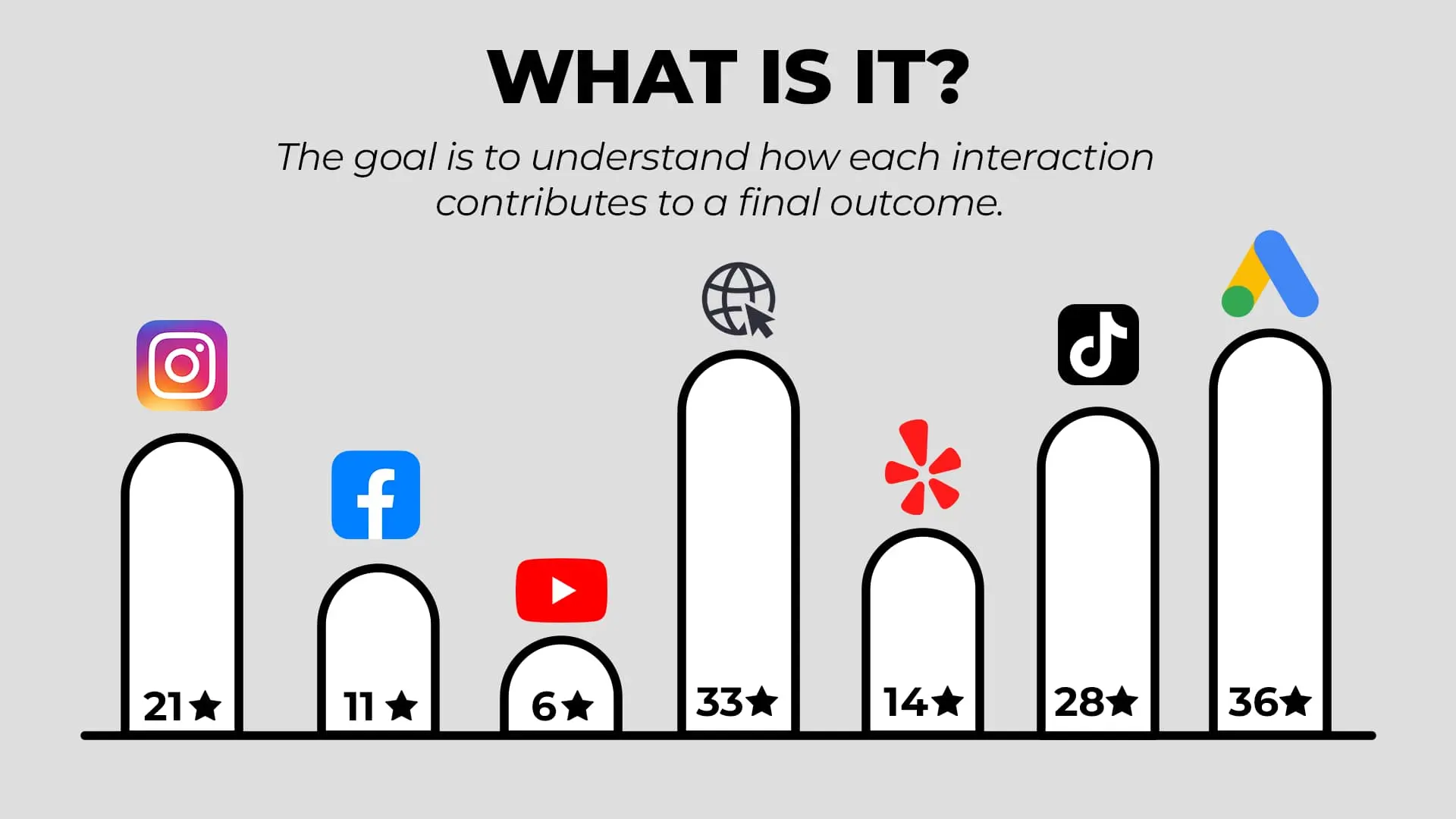
Marketing attribution is the practice of assigning credit for conversions to different touchpoints along a customer’s journey. The goal is to understand how each interaction contributes to a final outcome, such as a sale, form submission, or subscription.
According toGoogle Analytics Support, attribution models are rules or algorithms that determine how credit for conversions is assigned to various ads, clicks, and channels in conversion paths.
Attribution matters because it helps businesses:
- Identify which marketing channels drive the most valuable traffic.
- Optimize ad spend by shifting budgets toward effective campaigns.
- Improve cross-channel strategies with more accurate insights.
1. Single-Touch Attribution Models
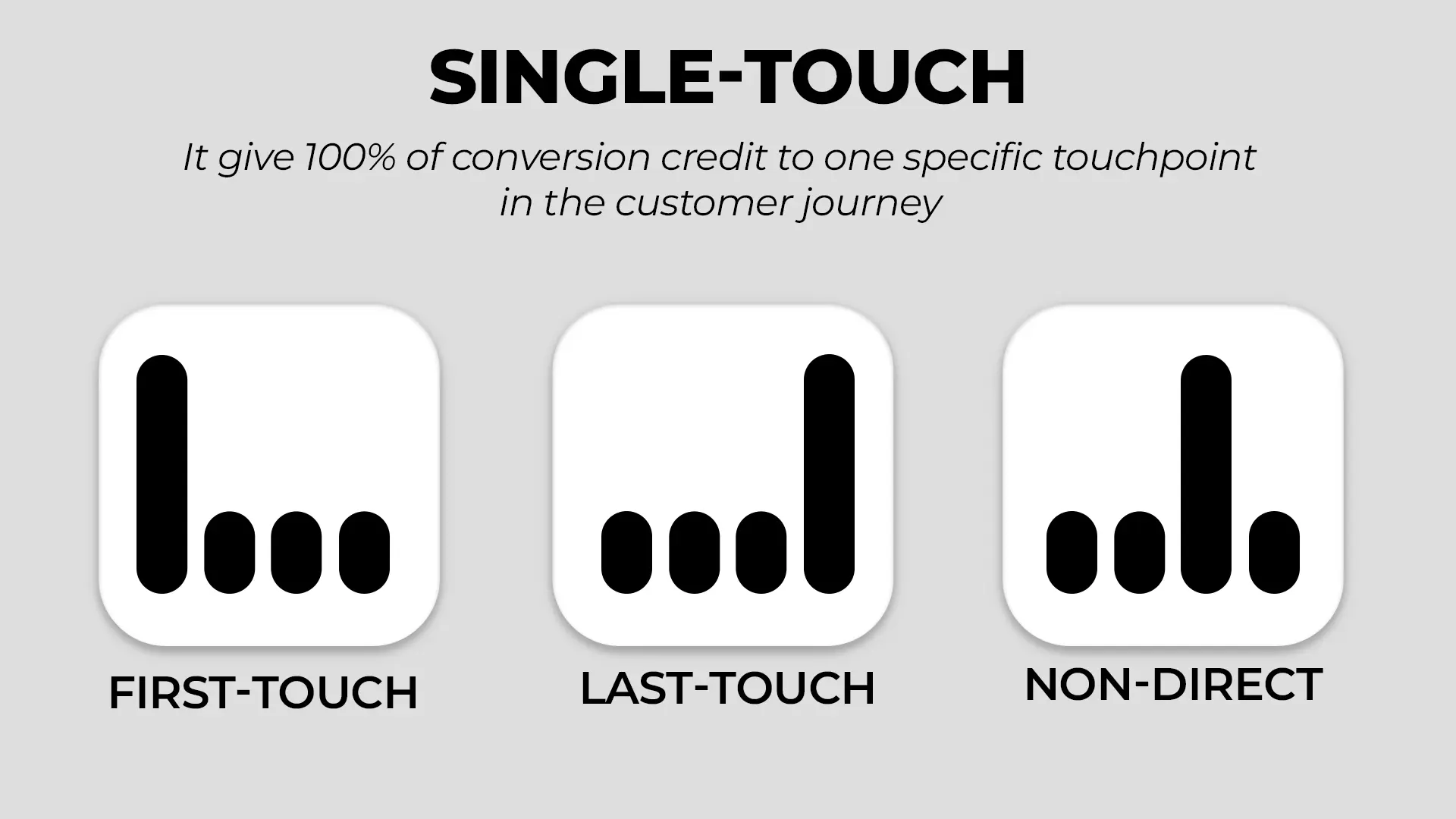
Single-touch models give 100% of conversion credit to one specific touchpoint in the customer journey. While simple, these models can distort the true value of other interactions.
First-Touch Attribution
In this model, the very first interaction a user has with your brand receives full credit for the conversion. It answers the question: “Which channel introduced the customer to us?”
When to use it:
- For campaigns focused on awareness or acquisition.
- To evaluate the performance of top-of-funnel marketing activities.
Limitations:
- Ignores nurturing and later influences that drive conversion.
- Can overvalue early discovery channels like social media or display ads.
Last-Touch Attribution
This model assigns all credit to the final touchpoint before conversion. It’s the default model in many analytics platforms.
When to use it:
- For campaigns where the final interaction is critical, such as retargeting or remarketing.
Limitations:
- Overemphasizes the closing channels while ignoring those that built initial interest.
- Can mislead marketers into cutting awareness campaigns that actually assist conversions indirectly.
Last Non-Direct Click
This variant ignores “direct” visits (when users type the URL manually) and instead assigns credit to the most recent non-direct interaction.
When to use it:
- When you want to reduce the distortion caused by direct traffic in reports.
2. Multi-Touch Attribution Models
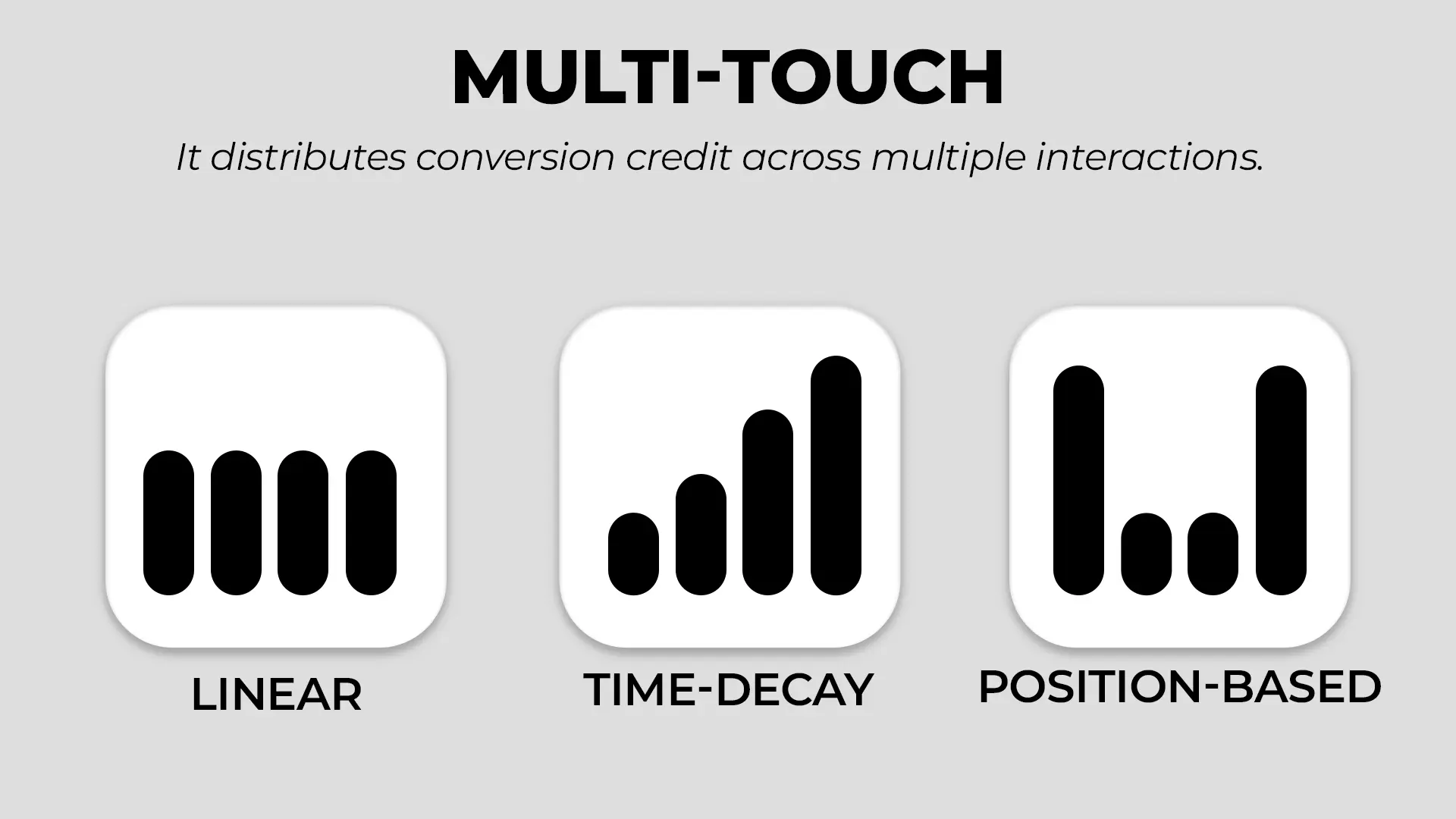
Unlike single-touch models, multi-touch attribution distributes conversion credit across multiple interactions. This approach better represents the reality of complex, non-linear customer journeys.
Linear Attribution
Credit is distributed equally among all touchpoints in the conversion path.
When to use it:
- When every interaction plays a relatively equal role in influencing conversion.
Advantages:
- Simple and transparent.
- Encourages balanced optimization across channels.
Disadvantages:
- Treats all interactions as equally important, which is rarely the case.
Time-Decay Attribution
Later interactions receive more credit than earlier ones, reflecting the idea that recent touches are more influential.
When to use it:
- For campaigns where recency drives purchase decisions, such as e-commerce or promotions.
Advantages:
- Reflects temporal influence.
- Captures the importance of retargeting and follow-ups.
Disadvantages:
- Can undervalue early brand-building efforts.
Position-Based (U-Shaped and W-Shaped)
U-Shaped Attribution assigns significant weight (often 40% each) to the first and last interactions, with the remaining 20% spread among middle touchpoints.
W-Shaped Attribution adds another emphasis point—typically at the middle of the funnel, such as lead creation—dividing credit more strategically.
When to use it:
- When both discovery and closing actions are critical in your marketing funnel.
Advantages:
- Balances upper and lower funnel credit.
- Aligns well with multi-stage customer journeys.
Disadvantages:
- Weights are subjective and may not match true performance impact.
3. Data-Driven Attribution
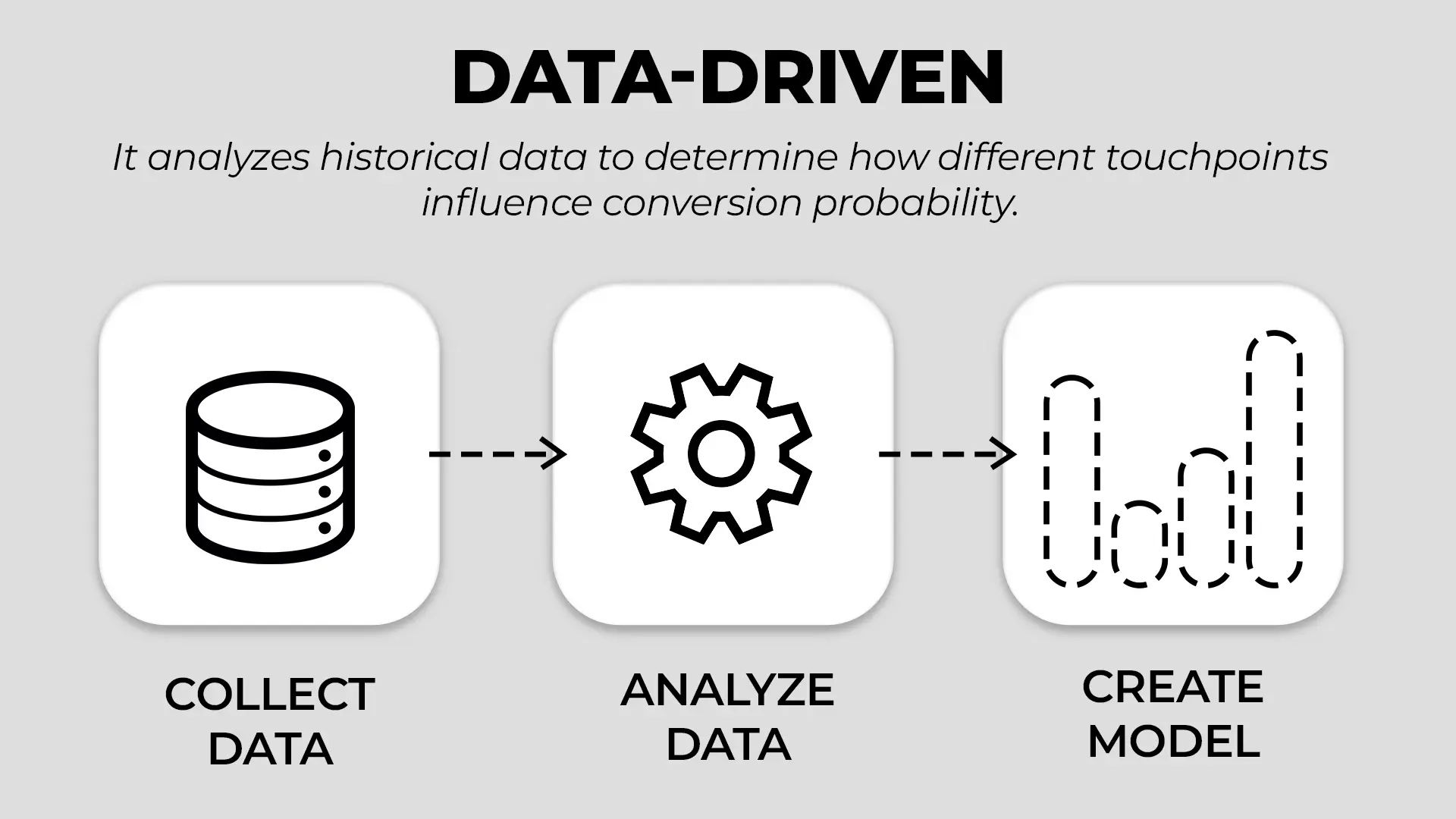
Data-driven attribution (DDA) is the most advanced model, powered by machine learning. It analyzes historical data to determine how different touchpoints influence conversion probability.
According toGoogle’s official documentation, DDA compares conversion paths that led to conversions with those that didn’t. It then calculates the incremental impact of each interaction, allocating credit proportionally to its observed contribution.
When to use it:
- When sufficient data exists to train reliable models.
- For enterprises running campaigns across multiple channels with measurable interactions.
Advantages:
- Reflects real user behavior rather than fixed assumptions.
- Adapts dynamically to channel performance changes.
- Reduces bias and improves attribution accuracy.
Disadvantages:
- Requires large datasets.
- Can appear opaque or difficult to explain to non-technical stakeholders.
4. Attribution in Google Analytics 4
Google Analytics 4 (GA4) has standardized Data-Driven Attribution as its default model for all conversion events.
As explained by Google Support, GA4’s data-driven approach uses machine learning to evaluate channel paths and assign fractional credit based on contribution probability.
Marketers can still compare models in the Attribution Reports section, choosing between last-click, first-click, linear, time-decay, and position-based. GA4 also allows historical reprocessing when switching models, ensuring continuity and consistency in analysis.
This shift toward data-driven measurement reflects Google’s long-term movement toward privacy-first analytics that balance accuracy with compliance and data protection.
5. Choosing the Right Attribution Model
Selecting the right model depends on your data maturity, marketing strategy, and funnel complexity.
| Business Context | Recommended Model | Reasoning |
|---|---|---|
| Awareness-driven campaigns | First-touch | Highlights acquisition sources |
| Short purchase cycles | Last-touch or time-decay | Focuses on closing performance |
| Long, multi-step B2B journeys | W-shaped or data-driven | Captures early and late influence |
| High-traffic e-commerce sites | Data-driven | Learns dynamically from user behavior |
| Limited data availability | Linear | Provides simple, balanced distribution |
Before standardizing on one model, marketers should run comparative tests to measure how model choice affects ROI and reported performance. Google recommends performing incrementality tests and holdout experiments to validate attribution assumptions (Think with Google).
6. Beyond Attribution: Unified Marketing Measurement
While attribution models explain “who gets credit,” they cannot always measure true incremental impact. That’s where Unified Marketing Measurement (UMM) comes in—a holistic framework combining multi-touch attribution (MTA), marketing mix modeling (MMM), and experimentation.
Google’s paper on Unified Marketing Measurement highlights that marketers should integrate these three approaches to overcome attribution blind spots:
- MTA for user-level digital insights.
- MMM for high-level budget allocation and offline measurement.
- Experiments to validate causality and eliminate bias.
ObserviX’s mission aligns naturally with this philosophy: bringing all marketing data into a single, AI-powered analytics ecosystem that empowers smarter decisions.
7. Best Practices for Implementing Attribution
- Start simple, scale later – Use rule-based models first, then evolve to data-driven as data volume grows.
- Align models with objectives – Awareness campaigns need first-touch logic; performance campaigns benefit from data-driven attribution.
- Maintain transparency – Educate stakeholders on how attribution works and why credit distribution changes.
- Validate results**** – Use controlled experiments or lift studies to confirm model accuracy.
- Iterate continuously – Consumer journeys evolve; your model should too.
Conclusion
Marketing attribution is no longer about choosing between first- or last-click models. It’s about understanding customer journeys through data, context, and experimentation.
Single-touch models offer simplicity but risk distortion. Multi-touch models improve balance but rely on assumptions. Data-driven attribution, supported by Google’s machine learning frameworks, provides the most accurate and adaptive view—provided there’s sufficient data and infrastructure.
For modern analytics platforms like ObserviX, the opportunity lies in combining these methodologies within one unified system. Empowering marketers with transparency, flexibility, and validation tools ensures attribution becomes not just a reporting mechanism, but a strategic growth driver.