

How Do Marketers Use Geographic Segmentation to Drive Engagement?
When Starbucks offers pumpkin spice lattes earlier in Seattle than in Miami, or when Nike showcases winter gear in Minnesota while promoting breathable fabrics in Arizona, you're witnessing geographic segmentation in action.
Geographic segmentation divides a broad market into smaller groups based on physical location, allowing marketers to customize offerings according to where people live, work, and play. This approach transforms generic marketing into locally relevant messaging that connects with audiences on a deeper level.
Have you ever noticed how a national brand somehow feels local when you interact with it?
This article explores how marketers use geographic segmentation to create precisely targeted campaigns that resonate with local audiences. Marketing professionals, product managers, digital agencies, business owners, and IT managers will discover actionable insights for enhancing campaign performance through location-based strategies.
What Is Geographic Segmentation, and Why Does It Matter?
Geographic segmentation is the practice of dividing your audience by physical location—country, region, city, neighborhood, or proximity radius—then tailoring marketing content, timing, and channels to match the needs of each group.
The core goal? Relevance. What resonates in Miami falls flat in Minneapolis.
Climate, culture, population density, and local traditions all shape consumer needs. Customer addresses, IP location data, mobile GPS information, and social media check-ins provide rich sources of geographic insights. A Colorado-based outdoor retailer, for instance, might position hiking gear differently than a Minnesota competitor who leads with ice fishing equipment—even if both sell the same product categories.
The location-based marketing market was valued at $23.72 billion in 2025 and is projected to reach $70.98 billion by 2030—a 23.32% CAGR (MarketsandMarkets, 2025). That growth reflects a fundamental shift: 71% of consumers now expect location-based personalization from brands they engage with (Salesforce, 2025), and 98% of consumers search online for nearby businesses before visiting in person (BrightLocal, 2025).
Geographic targeting improves engagement 20–35% versus non-targeted campaigns (Nielsen, 2024). When you narrow targeting to proximity level—customers within a few hundred meters—response rates hit 20%, with conversion increases of 124% (Proximity.io, 2024). Miss those signals, and a competitor's geotargeted campaign captures the click instead.
Key Ways Marketers Use Geographic Segmentation
Tailoring Marketing Messages
Geographic segmentation goes well beyond swapping out a city name in an ad headline. Effective localization means adapting language, cultural references, and visual elements to match what each audience actually recognizes.
Consider a regional bank in Boston using "wicked good rates" in their campaign copy versus the same bank's Texas branch leading with "everything's bigger—including your savings." Both campaigns sell the same product, but the messaging speaks each audience's language. Visual elements matter too—featuring recognizable local landmarks, regional landscapes, or community events strengthens the connection between brand and place.
Does your region have specific preferences that national brands should acknowledge? That's exactly the question geographic segmentation answers.
Product Customization and Localization
Some of the most successful geographic segmentation happens at the product level. McDonald's serves lobster rolls in New England and green chile burgers in New Mexico. Home Depot stocks hurricane shutters in Florida and earthquake retrofit kits in California. These aren't marketing gimmicks—they're inventory decisions driven by geographic data.
Technology companies apply the same principle. Navigation apps adjust for local traffic patterns. Ride-sharing platforms modify pricing by market density. SaaS companies localize feature sets based on regional compliance requirements—GDPR in Europe, CCPA in California.
The pattern is consistent: products that reflect local reality outperform generic alternatives.
Optimizing Send Times for Digital Campaigns
Timing is one of the most overlooked applications of geographic segmentation. A marketing email sent at 8 AM Eastern reaches New York audiences during their commute—but hits California inboxes at 5 AM, where it gets buried under overnight messages.
Time zone optimization alone shifts open rates 15–20%. The fix isn't complicated: segment your email and SMS lists by region, then schedule sends to arrive at the optimal local time. Email and SMS combinations with geographic segmentation deliver a 126.9% conversion lift over non-segmented outreach (Klaviyo, 2025). That's not an incremental improvement—it's a fundamentally different result from the same campaign.
Leveraging Local Trends and Events
Smart marketers monitor regional events, weather patterns, and seasonal trends to time their campaigns for maximum relevance. A roofing company running ads the day after a hailstorm. A beverage brand promoting iced coffee when temperatures cross 85 degrees. A SaaS company sponsoring a booth at a regional tech conference instead of a national one.
For SaaS businesses specifically, geographic segmentation informs compliance positioning (highlighting GDPR features for European prospects), vertical targeting (concentrating outreach in tech hubs like Silicon Valley, Bangalore, or Berlin), and localization decisions including language support and time zone optimization for webinars and demos.
Geo-Targeted Advertising
Platforms like Google Ads and Meta Ads Manager offer precision targeting by country, state, city, and even radius boundaries. For local businesses, this eliminates wasted spend on audiences who will never walk through the door. Multi-location chains can direct consumers to their nearest store with dynamic creative.
Mobile geofencing takes this further—triggering promotional push notifications when a customer enters a defined geographic boundary. In 2018, Burger King placed geofences around 14,000 McDonald's locations. When a customer with the BK app walked within range, they received a notification: a Whopper for one cent, redeemable only after leaving McDonald's. Nine days. 37:1 ROI. Over 1.5 million app downloads.
89% of marketers report higher sales from location-based marketing (Mobile Marketing Association, 2025). Geotargeted social posts generate 6x more engagement than national equivalents. AI-powered geo-personalization delivers a 45% engagement uplift versus manual geographic segmentation (Salesforce AI Research, 2025).
Geographic Scope: Side-by-Side Comparison
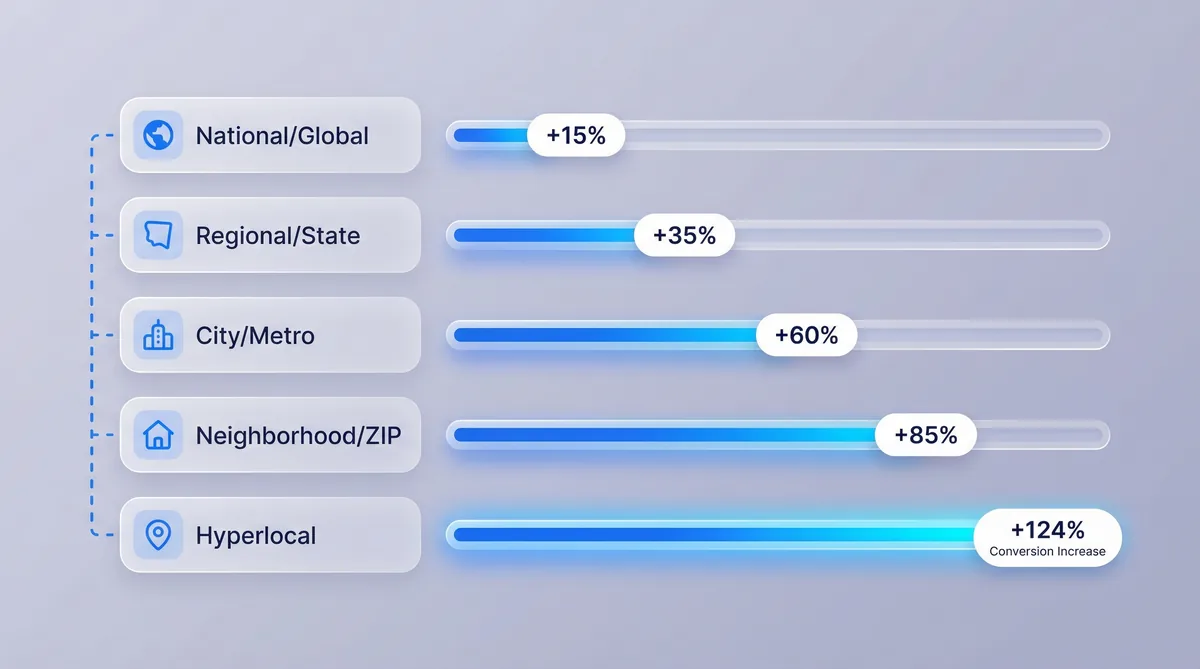
| Scope Level | Audience | Engagement Lift | Best Channel | Best For |
|---|---|---|---|---|
| National/Global | Very large | Baseline | Programmatic, TV | Brand awareness, product launches |
| Regional/State | Large | +20–25% | Paid social, OTT | Seasonal, cultural, regulatory variation |
| City/Metro | Medium | +30–35% | Search, display, email | Local promotions, competitive response |
| Neighborhood/ZIP | Small | +60–100%+ | SMS, geofenced social | Foot traffic, local services |
| Hyperlocal (meters) | Micro | 20% response rate, +124% conv. | Beacon push, in-app | In-store offers, real-time triggers |
As scope narrows, specificity rises—and so does engagement potential. The trade-off is reach: fewer people, but the right people at the right moment. Pairing these scope decisions with solid attribution analysis techniques ensures you read the results correctly at every level.
Overcoming the Challenges of Geographic Segmentation
Addressing Oversimplification of Consumer Behavior
The most common pitfall is assuming that everyone in a geographic segment behaves the same way. Two neighbors sharing a ZIP code may have entirely different lifestyles, income levels, and purchasing habits.
The solution is layering multiple segmentation approaches. Combine geographic data with demographic signals (age, income, education), psychographic data (values, interests, lifestyle), and behavioral metrics (purchase history, browsing patterns). A luxury hotel chain targeting high-income urban professionals, for example, would pair city-level geographic targeting with income and travel frequency data—not just location alone.
Geography tells you where. Behavior tells you intent. Both together tell you when to act.
Data Collection and Accuracy
VPNs can mask true locations. IP addresses sometimes map to outdated locations. Mobile GPS data varies in precision depending on device settings. These accuracy gaps can send your geotargeted campaigns to the wrong audience entirely.
Cross-reference multiple data sources—shipping addresses, IP data, GPS signals, and self-reported location preferences—to build a more reliable geographic picture. First-party data from loyalty programs and app registrations is both more accurate and more privacy-compliant than third-party location data. With GDPR cumulative fines surpassing EUR 5.88 billion, that compliance advantage isn't theoretical.
Refresh geographic segments quarterly. Consumer movement is faster than most CRM databases anticipate, and outdated segments quietly erode campaign performance.
Avoiding Overemphasis on Location
Geographic data is a powerful starting point, but it's not the complete picture. A single city—take New York—contains neighborhoods with vastly different demographics, cultural identities, and consumer behaviors. Treating Brooklyn and the Upper East Side as interchangeable audiences will produce generic campaigns that resonate with neither.
Use geographic segmentation as a foundation, then refine with A/B testing within segments. Test different messages, offers, and creative approaches to understand what actually drives engagement in each location—rather than assuming the ZIP code tells the whole story.
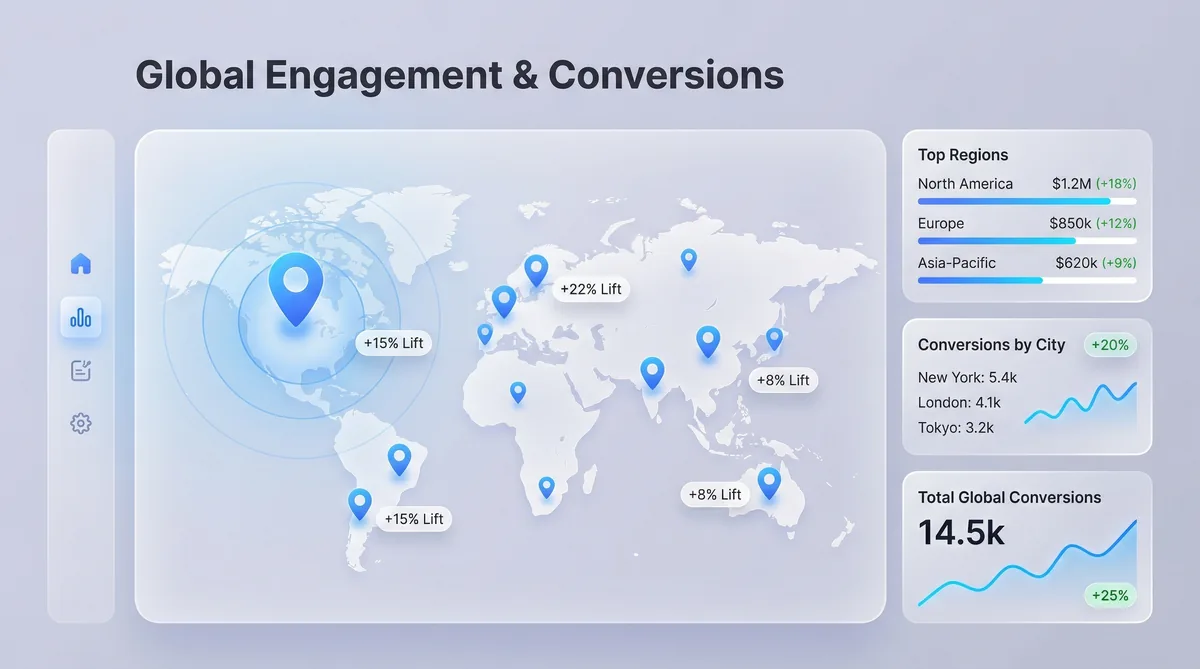
This is where analytics platforms earn their keep. ObserviX layers geographic engagement data with behavioral and conversion signals, so you can see not just where your audience is—but which locations actually drive revenue and which ones quietly drain budget.
Real-World Examples
McDonald's: Beacon Technology at Scale
McDonald's deployed beacon technology across select locations, triggering personalized push notifications when loyalty app users came within proximity. Offers were timed to peak foot traffic windows and tied to relevant menu items at each specific store.
Result: 8% sales lift in four weeks (McDonald's Case Study, 2024). At 40,000 locations globally, each percentage point of lift translates to hundreds of millions in systemwide revenue.
Starbucks: Proximity Meets Context
Starbucks combines proximity targeting with time-of-day signals. A push notification at 8 AM near a commuter-heavy store hits differently than one at 2 PM near a suburban location. Context—not just location—shapes the message.
Result: 23% engagement rate on location-triggered campaigns (Starbucks Digital Marketing Report, 2025)—3.3x to 4.6x above the 5–7% push notification industry benchmark.
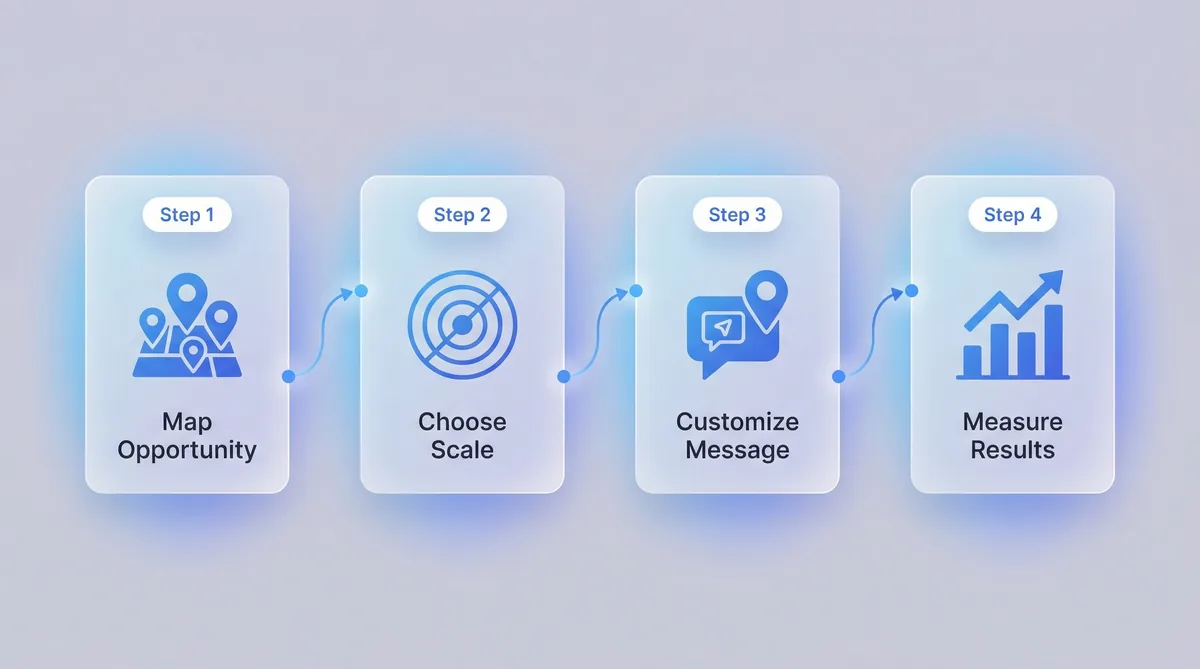
Both results come from the same mechanism: right message, right place, right moment. For a complete framework on how to measure marketing attribution at the campaign level—including geographic dimensions—that's the place to start.
Key Takeaways
- Consumer relevance changes by geographic scope in measurable ways—engagement lifts of 20–35% for targeted versus non-targeted campaigns, and 6x for hyperlocal social posts versus national equivalents.
- Geographic segmentation works across five layers: from national brand awareness down to hyperlocal proximity triggers. Each layer offers progressively higher engagement at the cost of reach.
- Layering is essential. Geographic data combined with behavioral and demographic signals outperforms location-only targeting. Don't treat geography as the whole story.
- First-party data is the foundation. Loyalty programs and opt-in data collection produce the most accurate and privacy-compliant location intelligence. Our B2C marketing attribution guide covers how to connect channel performance to actual revenue at the geographic level.
- Measure at the same granularity you target. Geographic campaigns without geographic attribution leave budget decisions as guesswork.
Understanding which geographic segments drive your highest-value conversions—and which consume budget without return—requires attribution that works at the market level. ObserviX connects location-level engagement data to actual revenue outcomes, so every geographic decision is backed by numbers, not instinct.