

Introduction
71% of B2B companies lack complete attribution of marketing touchpoints to revenue (Forrester, 2025). Meanwhile, B2B sales cycles now average 211 days—up 22% since 2022. CFOs are demanding ROI proof. And most marketing teams are still handing them click reports.
That gap costs you budget, credibility, and influence. This framework closes it.
What Is B2B Marketing ROI?
B2B marketing ROI measures the revenue your marketing generates relative to what you spend to generate it.
The core goal? Connect marketing spend to closed deals—not just leads, not just traffic, not just MQLs. Actual revenue.
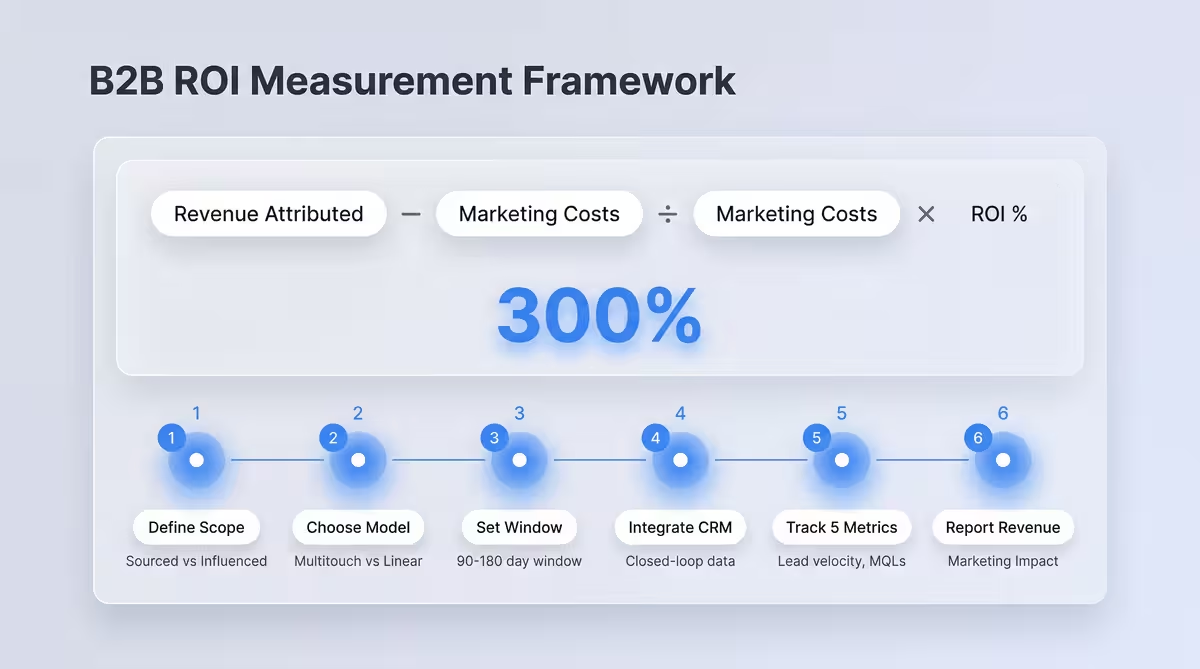
ROI = (Revenue Attributed to Marketing − Marketing Costs) ÷ Marketing Costs × 100
Spend $100,000, attribute $400,000—your ROI is 300%. Clean formula. Messy execution.
Why messy? Because in B2B, "revenue attributed to marketing" is where everything breaks down. Deals close months after first contact. Multiple stakeholders touch the same account. Marketing influences deals it never originated. The math is right; the data behind it usually isn't.
Two distinct categories matter here:
- Marketing-sourced revenue: Pipeline marketing originated. Benchmark: 30–40% of pipeline.
- Marketing-influenced revenue: Deals where marketing touched at least one stakeholder. Benchmark: 60–80% of pipeline.
Measuring only sourced revenue undervalues marketing by 20–40 percentage points. That's not a rounding error—it's the difference between a budget increase and a budget cut. For a complete playbook on tracking and improving these numbers, see our guide to measuring and improving marketing ROI.
Why B2B ROI Is Different
B2C marketers can attribute a purchase to an ad within hours. B2B teams can't—and shouldn't try to.
Here's what makes B2B attribution genuinely hard.
Sales cycles are long. The average B2B deal closes in 211 days. Enterprise contracts stretch to 379 days. B2C attribution windows run 7–30 days. Apply that window to a B2B deal and you'll see only the final click—missing every touchpoint that actually built the case. B2B needs 90–180 day attribution windows at minimum.
Buying committees are large. SMB deals average 6.8 decision-makers. Enterprise deals involve 12–13 stakeholders, with 89% of B2B purchases spanning multiple departments (6sense, 2024). Each person researches independently. Last-touch attribution credits whoever clicked the demo form—and ignores everyone who shaped the decision months earlier.
The dark funnel is real. 70–84% of the B2B purchase decision completes before a prospect contacts sales (Corporate Visions, 2026). Buyers research, compare, and evaluate through content, peer communities, and third-party reviews that your CRM never sees.
Translation: A 30-day window on a 211-day sales cycle captures the last 14% of the buyer journey and calls it attribution. The other 86% disappears—along with credit for every channel that built it.
When to Measure
Timing determines which insights are actually available to you.
- Monthly: Leading indicators—MQL volume, MQL-to-SQL rate, cost per MQL, pipeline added
- Quarterly: Marketing-sourced pipeline value, pipeline velocity, attribution performance by channel
- Annually: True revenue ROI, CAC payback period, channel-level ROI rankings
One critical setup rule: Configure your attribution window before any campaign launches—not after. If your average deal takes 211 days, your window must be at least 180 days. A campaign that generated an MQL in month two deserves credit for the deal that closed in month seven. Set the window after the fact and that credit vanishes.
The B2B ROI Framework: Step by Step
Step 1: Define what you're measuring. Decide upfront whether you're tracking sourced revenue, influenced revenue, or both. Set targets. ABM programs typically push marketing-influenced revenue to 65–85% of pipeline—well above the standard 60–80% baseline.
Step 2: Choose your attribution model. Last-touch—still used by 67% of B2B teams (RevSure AI, 2025)—credits whoever triggered the demo form while ignoring six months of relationship-building. Multi-touch adoption has grown from 31% in 2020 to 56% today. Algorithmic multi-touch delivers 15–25% more accuracy than rule-based models. For most teams, start with linear or time-decay. Move to algorithmic as your data matures and your CRM hygiene improves. Our breakdown of every attribution model type covers the full comparison—first-touch through data-driven AI—so you can match the model to your sales cycle and data maturity.
Step 3: Set your attribution window. Match it to your actual sales cycle—not an industry average. Enterprise teams averaging 12+ month deals should run 365-day windows.
Step 4: Integrate your CRM. Without closed-loop reporting, you can't connect touchpoints to closed deals. CRM technology delivers $8.71 for every $1 spent and lifts lead conversion by 17% (CRM Statistics, 2025)—but only when data is consistently and correctly tagged at every stage.
Step 5: Track the five metrics that matter.
- Marketing-Sourced Revenue — Pipeline marketing originated
- Marketing-Influenced Revenue — Pipeline where marketing touched any stakeholder
- CAC — (Marketing + Sales Spend) ÷ New Customers. Average: $536 B2B; $702–$1,200 SaaS
- MQL-to-SQL Conversion Rate — Average 13%; top performers 25–35%; SEO-sourced: 51%
- Pipeline Velocity — Speed deals move through the funnel
Step 6: Report in revenue language. This one matters more than people expect. "We generated 120 MQLs" becomes "We sourced $480,000 in pipeline at a cost of $32,000—a 15:1 pipeline ROI." Present pipeline value, not lead counts.
The CFO translation is direct: swap impressions for pipeline contribution, swap clicks for MQL-to-SQL rate, swap engagement for revenue influenced. Same data. Completely different conversation.
Best Practices
On data and attribution: Set attribution windows before campaigns launch—not after. Track anonymous visitors; 90% of B2B teams skip this (RevSure AI, 2025), missing pre-identification research that shapes most deals before anyone fills out a form. First-party data delivers 1.5x higher marketing ROI and 2.9x better retention versus third-party approaches (S2W Media, 2025).
On measurement architecture: Measure at the account level. With 6–13 stakeholders per deal, lead-level tracking fragments the story and creates a false picture of where influence lives. Separate sourced and influenced reporting from the start—conflating them causes credit arguments instead of budget decisions. Platforms like ObserviX unify CRM, ad, and analytics data into a single attribution view, making account-level measurement practical from day one.
On reporting: Always include influenced revenue alongside sourced. Sourced-only reporting hides 40–50% of marketing's actual contribution. Benchmark MQL-to-SQL by channel: SEO converts at 51% versus Google Ads at 7–12%. That's not a marginal difference—it's a 4x gap that should directly shape how you allocate spend.
Common Mistakes to Avoid
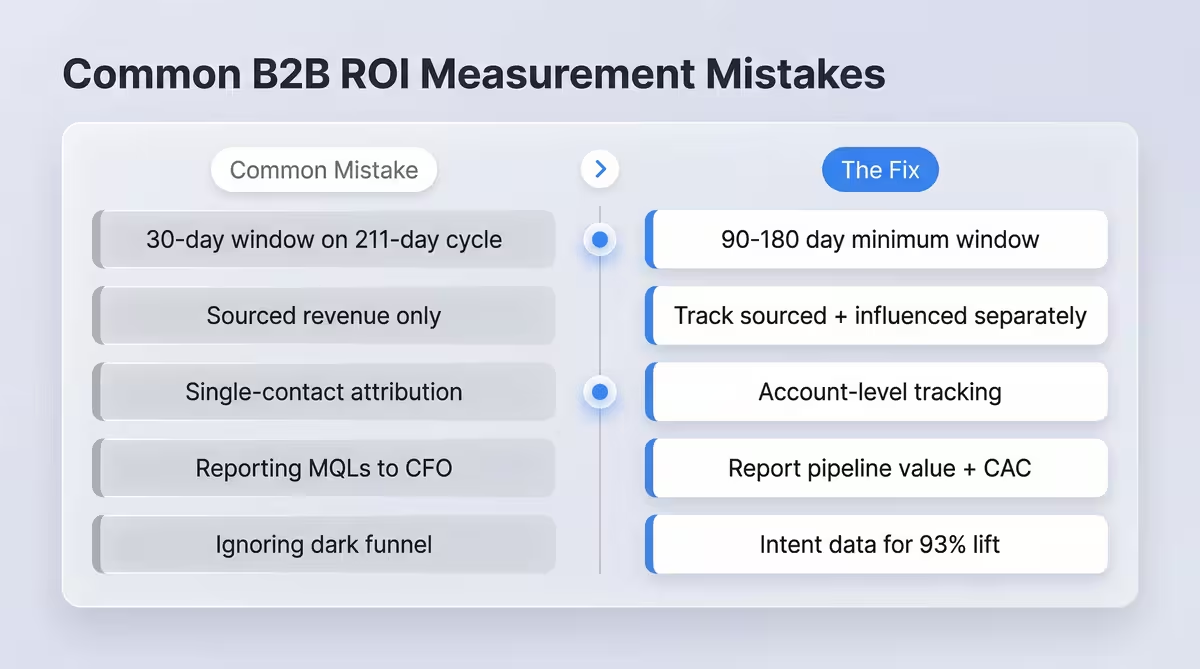
Mistake 1: Using a 30-day window on a 211-day sales cycle.
This captures only 14% of the average B2B journey. Every channel that built awareness in months one through six gets zero credit. Content campaigns appear worthless. Budget gets cut.
The fix: Set 90–180 day windows at minimum. Enterprise teams should run 12–18 months.
Mistake 2: Measuring only marketing-sourced revenue.
If marketing influenced a deal it didn't source, last-click models assign that revenue to sales. Marketing's contribution disappears from the report entirely.
The fix: Track both sourced and influenced separately in your CRM opportunity records.
Mistake 3: Ignoring the buying committee.
Single-contact attribution assumes one person decides. In B2B, it's 6.8 to 13 people—each researching independently through different channels at different times.
The fix: Account-level attribution maps all stakeholder contacts to their company record. One account, unified view.
Mistake 4: Reporting marketing metrics to finance.
CFOs don't care about impressions or organic rankings. They care about revenue and return.
The fix: Translate first. "Webinar series" becomes "touched 43 active opportunities representing $1.8M in pipeline."
Mistake 5: Ignoring the dark funnel.
Most early B2B research happens in channels you can't track—communities, peer recommendations, content consumed before cookie consent. It shapes decisions. Your CRM never sees it.
The fix: Intent data drives 93% conversion improvements for teams that implement it (The Insight Collective, 2025). Dark funnel isn't invisible—it's just unmeasured. Intent data changes that.
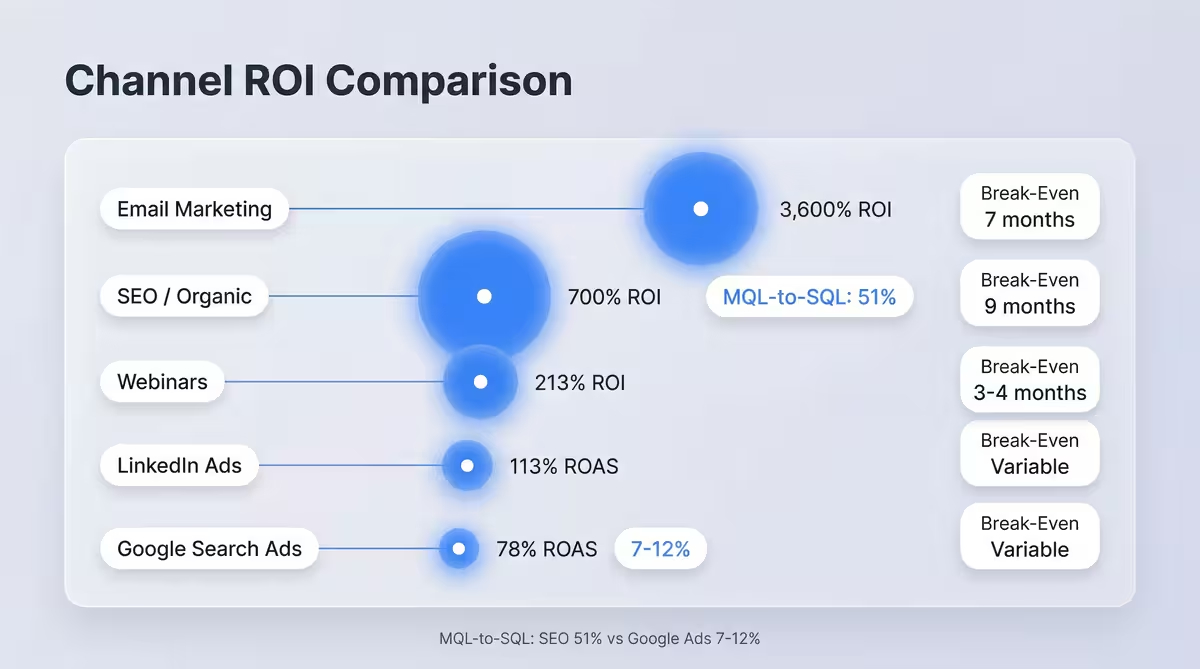
Channel ROI Comparison
| Channel | ROI / ROAS | MQL-to-SQL | Break-Even | Best Use Case |
|---|---|---|---|---|
| Email Marketing | $36–$40 per $1 (3,600%+) | 0.9% | 7 months | Nurture, existing database |
| SEO / Organic | 700–748% ROI | 51% highest | 9 months | Long-term pipeline, authority |
| Webinars | 213% (430% SaaS) | High-intent | 3–4 months | Enterprise consideration |
| LinkedIn Ads | 113% ROAS | 14–18% | Variable | ABM, enterprise top-of-funnel |
| Google Search Ads | 78% ROAS | 7–12% | Variable | High-intent demand capture |
Sources: HubSpot, Data-Mania, HockeyStack Labs, Swydo, 2025–2026
Note that the table above mixes ROI percentages with ROAS figures—they measure different things. If you're unsure when to apply each metric, our ROAS vs ROI comparison explains the distinction and when each metric gives you a more accurate read on channel performance.
SEO's 51% MQL-to-SQL rate—4x higher than Google Ads—reflects one simple reality: organic search captures buyers who are already researching. Intent arrives with the lead.
LinkedIn's higher CPC ($5–6 versus Google's $2.69) is consistently justified by double the lead quality. LinkedIn B2B ad spend grew 31.7% year-over-year in 2025; Google Search grew 6%. The market is voting.
Real-World Example: PayScale's 6x ABM ROI
PayScale, a compensation data company, needed to prove the ROI of its account-based marketing program in terms that would survive CFO scrutiny.
They moved from last-touch reporting to account-level multi-touch attribution—tracking every marketing touchpoint across target accounts, not just inbound lead forms—and shifted reporting to pipeline value rather than lead counts.
Results after 7 months (RollWorks):
| Metric | Result |
|---|---|
| ABM program ROI | 6x return |
| Target account traffic | +500% |
| Sales cycle length | −45% |
That 45% cycle reduction—roughly 95 days off each deal—compounded the ROI further. What changed wasn't the channels. It was the measurement architecture: account-level tracking, touches linked to CRM opportunities, and pipeline-value reporting instead of lead counts.
Same budget. Completely different attribution picture. The same principles apply at any scale.
Key Takeaways
- Set attribution windows to match your sales cycle—90–180 days minimum. Short windows systematically undervalue every channel that built the deal before the close.
- Measure both sourced (30–40%) and influenced (60–80%) revenue. Sourced-only reporting hides nearly half of marketing's actual contribution.
- 71% of B2B companies lack complete attribution (Forrester, 2025)—basic multi-touch setup puts you ahead of most competitors immediately.
- MQL-to-SQL rate by channel drives budget decisions. SEO: 51%. Google Ads: 7–12%. Follow the data, not the instinct.
- Report in CFO language. Pipeline sourced, pipeline influenced, CAC, and MQL-to-SQL are the metrics that survive a budget review. Impressions don't.
Ready to stop guessing which channels drive revenue?
ObserviX connects your CRM, ad platforms, and analytics stack into a unified attribution view—so every touchpoint is tracked, every channel is credited, and your ROI reports stand up to CFO scrutiny.